I bought my Fancierstudio press in April 2025, after a whole winter of pressing Mason's Little League shirts with a household iron and watching the letters curl up by the third wash. I had never used a heat press before. I did not know what a platen was. What I did know was that I wanted the machine that gave me the fewest ways to ruin a shirt while I learned.
Nineteen months later, that clamshell press still sits on the six-foot table Ray built in our spare bedroom, and I still use it two or three times a week. What follows are the ten reasons it turned out to be the right first machine for someone like me. If you are standing in the craft aisle wondering whether you are allowed to buy one of these, this is for you.
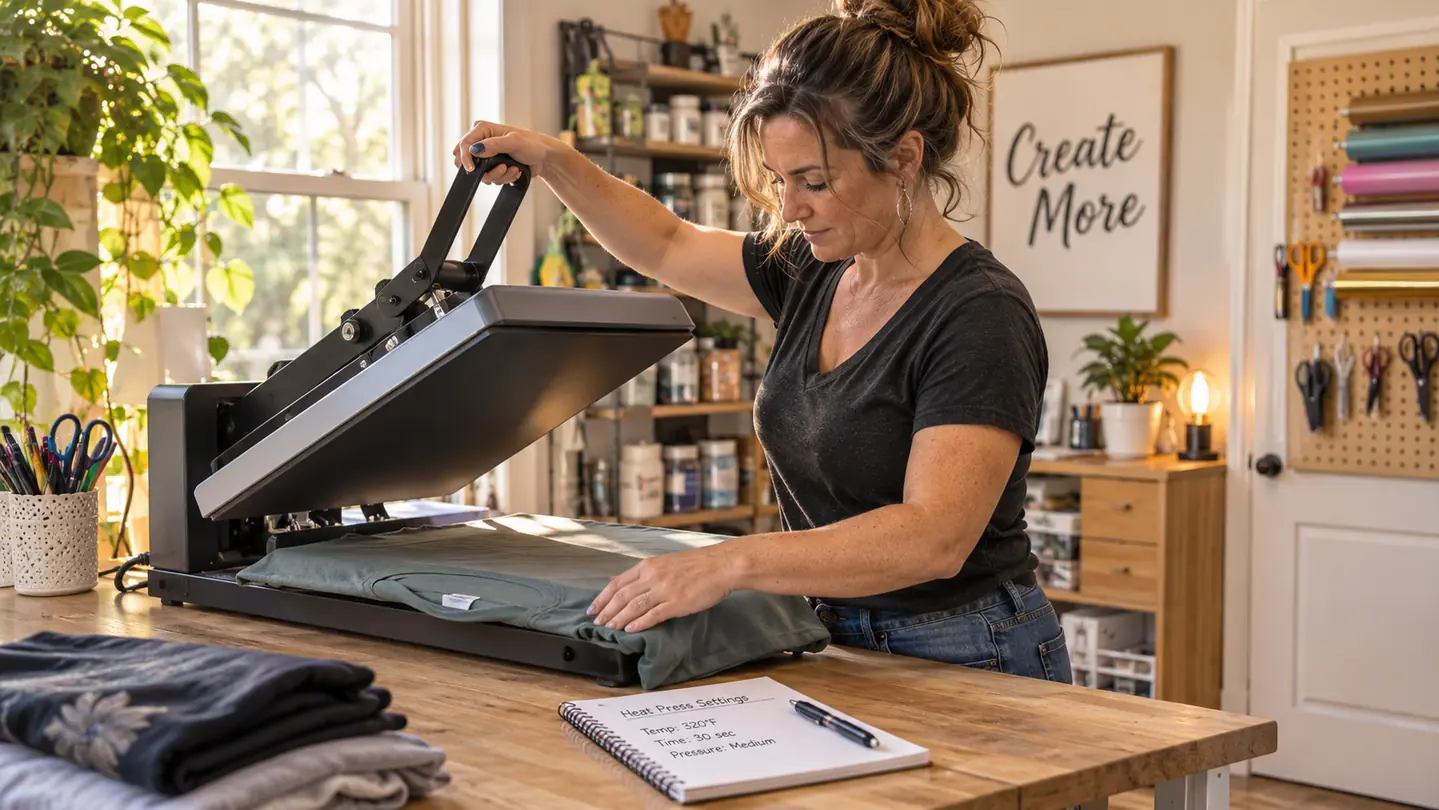
The press I learned on, still on my table nineteen months later
The Fancierstudio 15 by 15 clamshell is the machine I bought in April 2025 and never replaced. If you want a first press that forgives a beginner, start with the one that already did.
Amazon Check Today's Price on Amazon →You open it with one handle, so there is nothing to line up
A clamshell press has a top half and a bottom half joined at the back, and the handle lifts the whole top half up and over. I am not a strong person and I do not have to be. You lay the shirt on the flat lower pad, arrange your design, then pull the handle down and the heated top comes to meet it. There is no arm swinging across the room and no second motion to remember. For my first twenty shirts I judged pressure and placement by feel, because there was only one motion to feel.
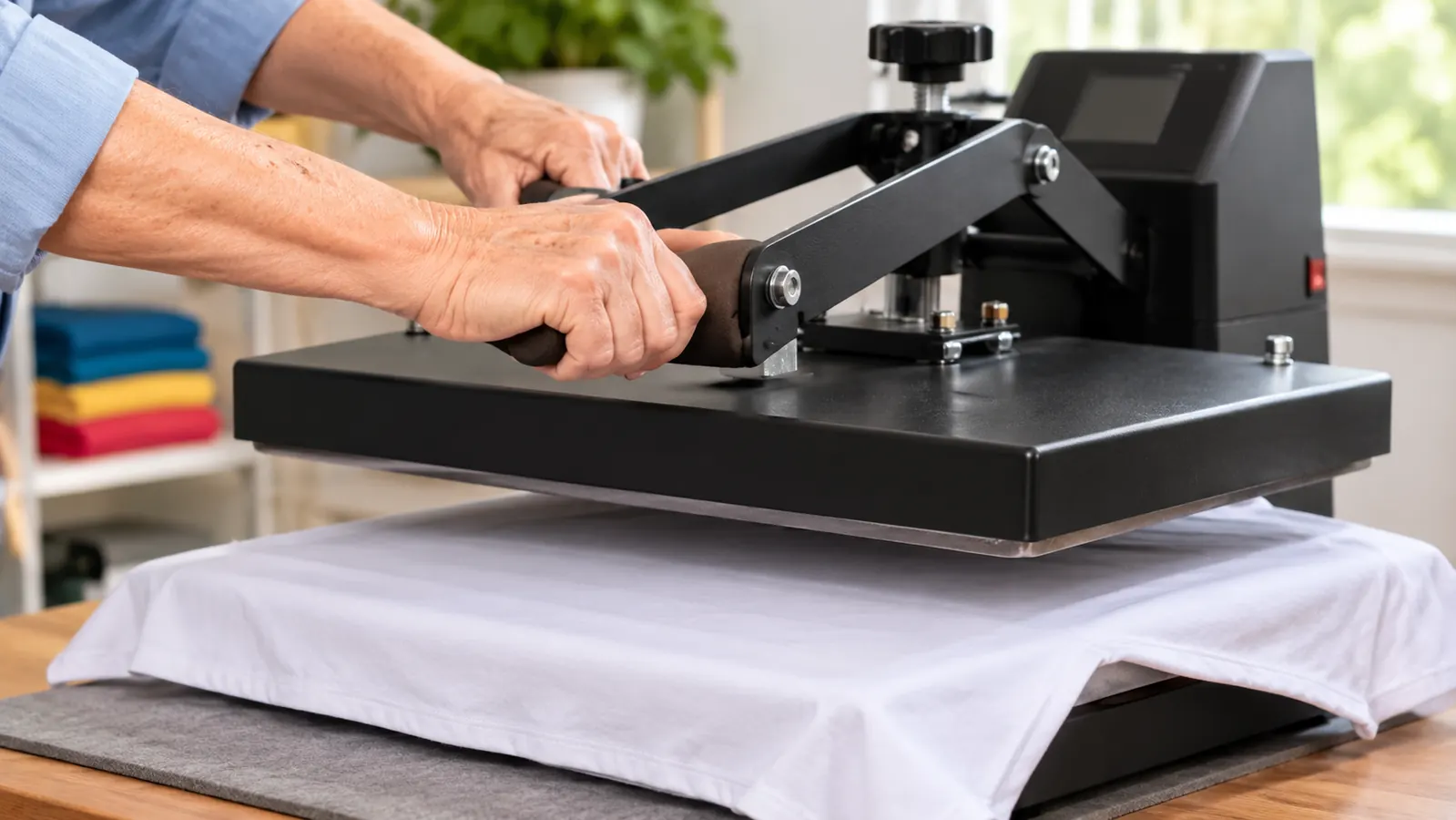
The 15 by 15 inch platen covers a whole adult shirt front in one press
The platen is 15 inches by 15 inches, which is the printable front of a men's large. Mason's youth smalls look almost silly sitting on it, and Lily's size 7 shirts have room for a name and a graphic and still leave a margin. My iron work needed two or three passes and never quite lined up with itself. With the Fancierstudio I place the shirt once, close it once, and the entire design takes the same heat for the same time. That evenness is what fixed my peeling letters more than anything else did.
The digital control takes the guessing out of time and temperature
This press has an electronic control for both heat and time, with a temperature range the listing gives as 0 to 699 degrees Fahrenheit and a time range of 0 to 999 seconds. I write down what worked for each blank in a spiral notebook and set the same numbers the next time. In the beginning I was adjusting an iron by feel, which is a polite way of saying I was scorching things. Now the press counts down, beeps, and I lift the handle. For a beginner the beep matters more than it sounds like it does.
The Teflon coated platen gives you a little grace
One of the features on the listing is a Teflon coating on the heat platen. What that meant in my house is that the first shirt I scorched did not leave a crust on the surface I press on. I have seen older machines at our church craft group with a platen that looks like a frying pan nobody washed, and I have wiped mine down with a damp cloth and gone back to work. Every beginner will scorch something. The only question is whether the scorch costs you a shirt or costs you the machine.
It fits on one end of a six-foot table in a spare bedroom
The press measures 33 inches long, 23 inches wide and 20 inches high, and mine sits on a heat-resistant mat at one end of Ray's table. That leaves me room to lay out blanks on the other end and still reach the window when the room gets warm. My craft room is a converted bedroom, not a shop, and I do not have a garage bay to hand over to equipment. If your space is a corner of a room, measure it against those numbers and you will know before you order.
Shirts, tote bags and mouse pads all use the same flat platen
The listing recommends this press for t-shirt, bag and mouse pad work, and that matches my own table. Most of what I make is shirts, but I press canvas tote bags for the church fall festival and mouse pads for the kids' teachers. Flat things with a bit of give are what this press likes. Pillow covers work too if you slide a pressing pad inside so the seams do not leave you a ridge. I learned that one the hard way, on a cover that came out with a line straight across the middle.
Rhinestones and sublimation run on it too, so one machine covers the next thing
The machine is sold as a sublimation and rhinestone press as well as a shirt press, and I have used mine for both heat transfer vinyl and sublimation. When I brought the Epson F170 home in September 2025, I did not need a second press to go with it. I press sublimation on shirts and totes with A-SUB paper, and the same platen handles the job. Buying one machine that covers the next thing you want to try is worth more to a beginner than buying two narrow ones you grow out of.
You can see the whole shirt while you place the design
On a clamshell the shirt lies flat on the bottom pad with the top half raised well out of the way, so you are looking straight down at your design while you line it up. My first month I used a ruler and checked the spacing twice, and the open press made that easy rather than awkward. It also means you spot trouble instantly, like a corner of vinyl that has folded back on itself or a letter that shifted. Those two problems caused most of my early rejects.
The heat sits up and away when the press is open
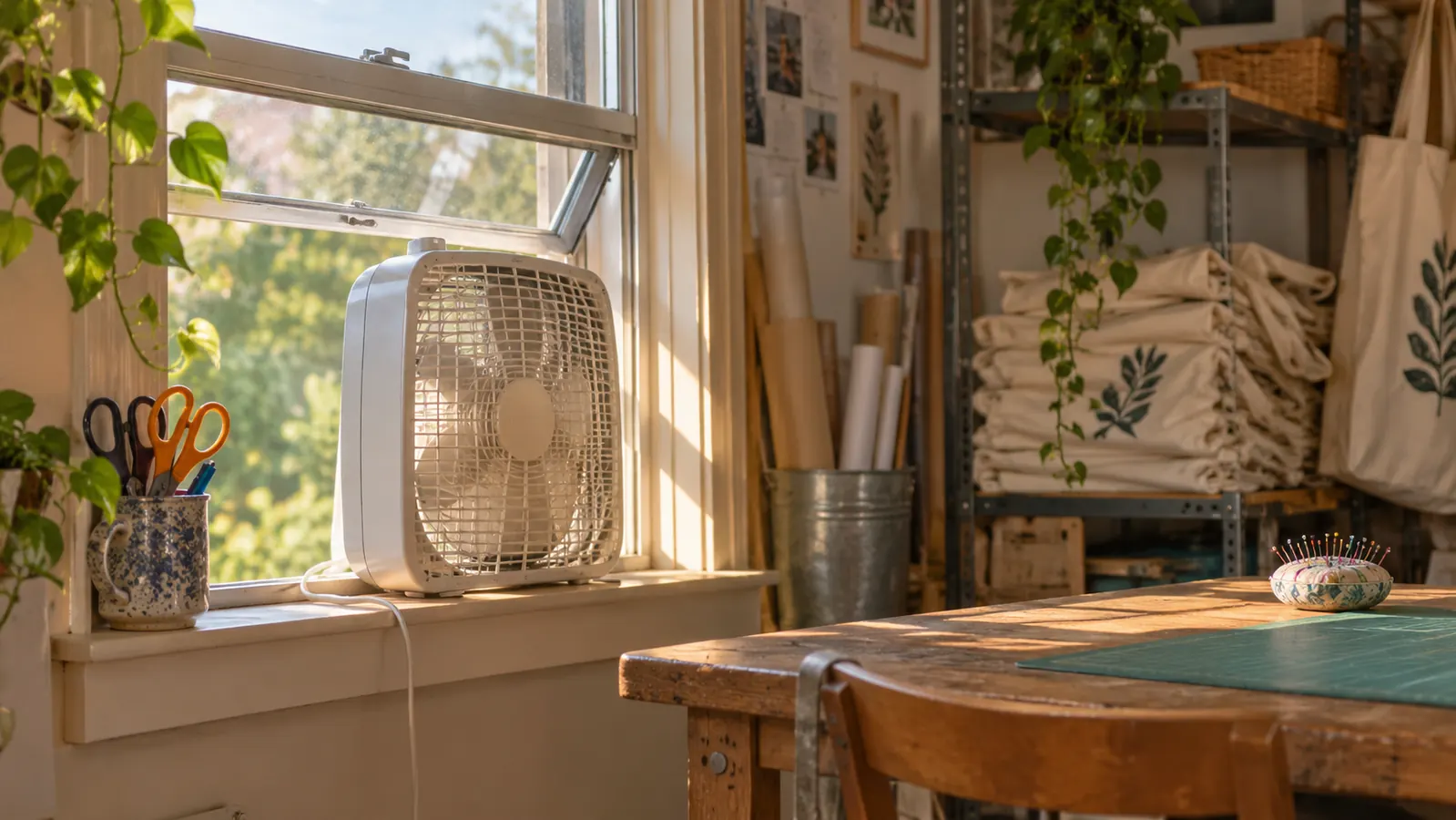
The heated platen on this machine is the top half, so with the handle up the hot surface faces away from the table and away from the pad you load. That is the reason I felt all right having it in the house with Mason and Lily around. It is not a reason to relax. That platen is hot enough to burn a hand that reaches for it, so the rule here is that the press is mine, the kids do not touch it, and Pepper gets shut out of the craft room the whole time it is on. The window stays open, the box fan runs, and I never leave the room with it powered up.
The learning curve is a weekend, not a season
I ruined about a dozen shirts in my first two months. Wrong pressure, wrong temperature, a vinyl meant for a different fabric. What I did not have was a machine problem. I say that because beginners blame the press for what is almost always a setting. Fancierstudio gives you a temperature range, a timer and a handle, and the rest of it lives in your notebook. By late summer of 2025 I was pressing Mason's team shirts on a Friday night without thinking about it, which is the real sign you have learned a machine.
What I'd Skip
If you are shopping for a first press, here is what I would not bother with. I would skip a bundle that throws in vinyl and blanks you did not choose, because within a month you will buy the colors and sizes you actually want. I would skip any press too big for the room you have, because a press you have to drag out and set up is a press you stop using. And I would skip the urge to order a stack of blanks before you have done one test press on a rag shirt. This one carries a three month warranty, which tells you the maker expects you to learn on it and get on with it. Do the test press. Write down the setting. Then do the real shirt.
I ruined about a dozen shirts in my first two months on this press, and not one of those was the machine's fault.
Start on a press you will not have to replace in a year
The Fancierstudio 15 by 15 has been on my table since April 2025. It handles vinyl, sublimation and rhinestones, and it fits in a spare bedroom. Open the window, keep the kids and the cat clear of it, and never walk away while it is on.
Amazon Check Today's Price on Amazon →