Two of my first five tumblers came out of the kitchen oven with a pale ghost band around the middle and a hard seam line down one side, and I could not figure out what I had done wrong. I had followed the videos. Shrink wrap, timer, rotate halfway through. It did not matter. An oven heats a whole cavity at once, and a tumbler is not a cake. Once the wrap wrinkles, you have baked that wrinkle into the coating and no amount of re-pressing gets it out.
That was November and December of 2025. In January 2026 I bought the HTVRONT Auto Tumbler Heat Press, and it has sat at the end of the six-foot table Ray built me ever since. Ten months now. I am not a print shop. I am 61, I retired after 28 years running a school cafeteria, and I make 20 oz skinny tumblers for friends, for our church fall festival and for two or three local craft fairs a year. But I have pressed enough of them on this machine to know where it earns its space on my table and where it still asks you to pay attention.
The Quick Verdict
Ten months of steady hobby use and the ghosting stopped the week it arrived. The pressure pad does evenly what my hands used to do badly, and the diameter range covers every blank I actually buy. It will not rescue a wrinkled wrap or a skipped test.
Amazon Check Today's Price →The ghosting stopped the week this press landed on my table
The HTVRONT Auto Tumbler Heat Press handles tumblers from 2.9 to 3.2 inches in diameter and blanks from 280ml to 850ml, and the R button halts heating and releases the heat pad the moment you press it. Ten months of my own use, and I still run a test blank before every new batch.
Amazon Check Today's Price on Amazon →How I've Used It
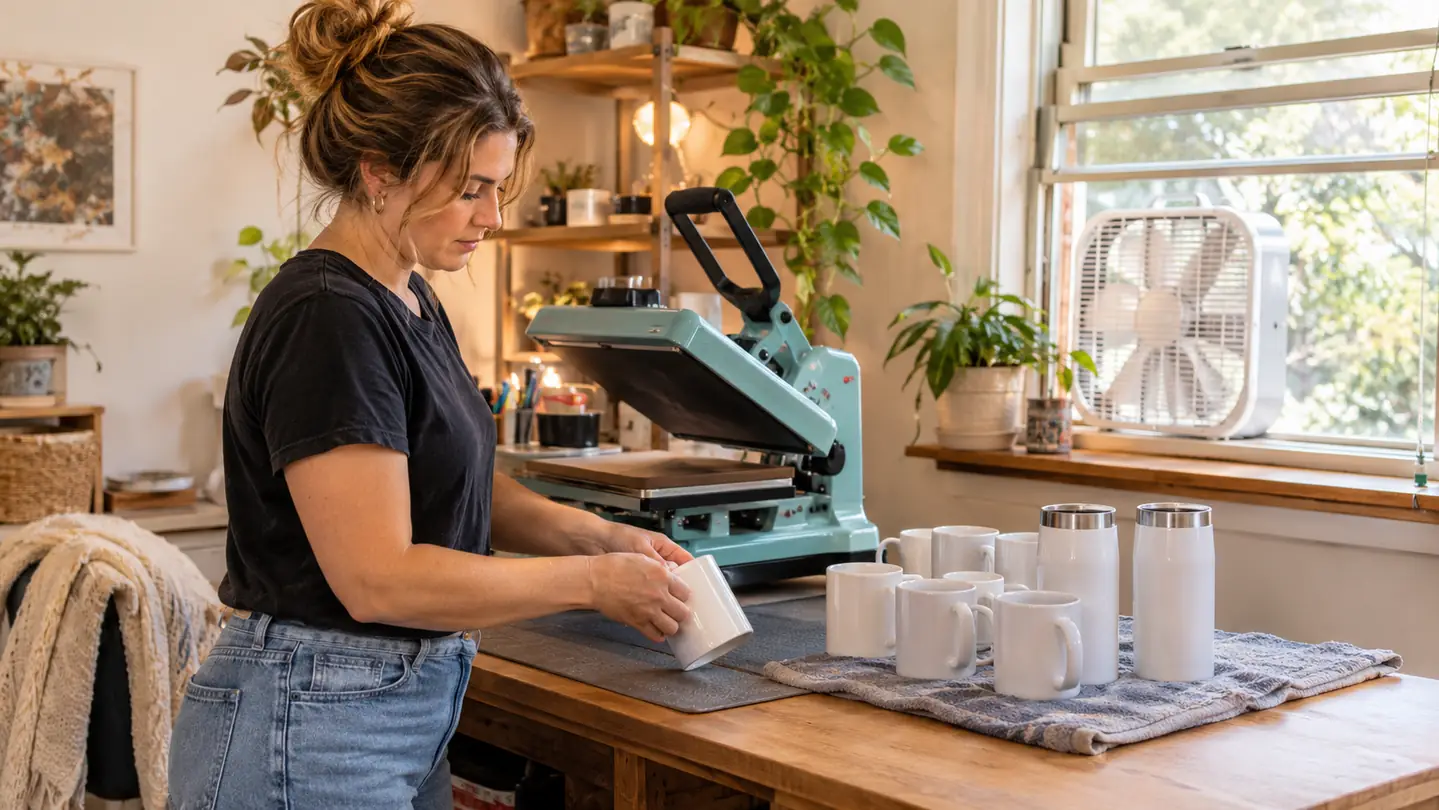
The press lives in the spare bedroom that I call the craft room, on the sturdy table Ray built, sitting on a heat-resistant mat. The window stays open while the press is on and there is a small box fan on the sill pulling air across the room. I will say this plainly because it matters more than any setting: the surface gets hot, my grandkids Mason and Lily are not allowed in that room when it is on, and Pepper the cat is shut out with the door closed. I never leave it running and walk away, not even to answer the phone. If you take nothing else from this review, take that part.
A session for me looks like this. I print the wrap the night before on the sublimation printer, let it dry, and trim it. The next morning I tape the wrap onto the blank with heat tape, snug but not fighting it, and check the seam line twice because I have learned that lesson. Then the blank goes into the press, I press the button, it closes and holds, and the timer on my own phone tells me when to look. Ten months of doing it this way means I no longer hover. That is the real change. With the oven I hovered and it still went wrong.
I make 20 oz skinny tumblers more than anything else, which is what most of the blanks at the craft store are. I also do mugs, and I do shirts and tote bags on the clamshell press that came before this one. The tumbler press is one job only and I like it that way. It sits on the mat, it does drinkware, and the shirts stay on the other side of the table where they belong.
What the Auto Press Actually Does Differently
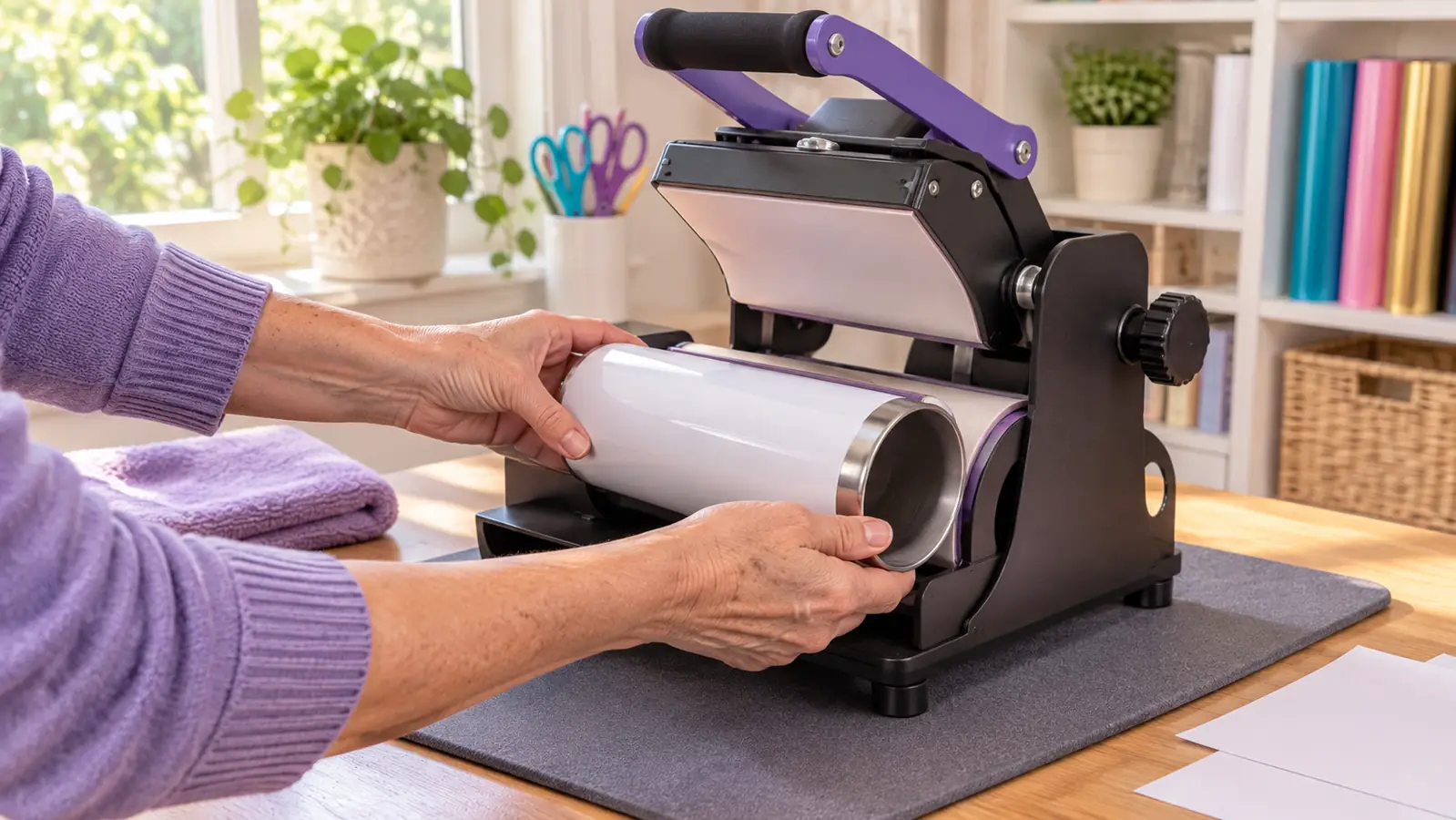
The word auto in the name is doing real work. On a manual tumbler press you crank a handle or squeeze a clamp and your own grip sets the pressure, which means the pressure changes from the first tumbler to the eighth because your hands get tired. On this one you load the blank, press the button, and a pad closes around the tumbler and holds. Same pressure on tumbler one and tumbler eight. That consistency is the whole reason my seam lines went away, because pressure that varies is pressure that ghosts.
The R button is the detail I did not expect to care about and now use every single time. Press it and the machine halts heating and releases the heat pad instantly. You are not standing there waiting for a slow cool-down with a hot tumbler trapped inside, and you are not tugging at a pad with your fingertips. The blank comes out, goes onto a folded towel, and the press is open and cooling while you set up the next one. In a batch of six, that adds up to a lot less standing around.
The temperature range runs from 210 °F up to 390 °F, which covers everything I make and everything the blanks in my cupboard ask for. I have never needed the top of that range and I have never needed the bottom, but I like knowing the machine is not the thing limiting me. Two women in my church craft group use tumbler presses too, different brands, and the thing all three of us say is the same: it is not the press that decides whether the tumbler comes out clean, it is the wrap and the test.
The Numbers on the Box That Actually Mattered
The spec that decided it for me is the diameter range: 2.9 inches to 3.2 inches. That is not a wide window on paper. It is exactly the window I live in. The 20 oz skinny tumblers I buy sit in the middle of it, and the slightly fatter water bottles I have tried also fit. When I was shopping, I read listing after listing and got lost in wattage and warranty years, then realized the question that actually mattered was simpler. Will it hold the blanks I already own? For me the answer was yes, and it has stayed yes for ten months.
The capacity figure is 280ml to 850ml. Practically, that means small cups on one end and the bigger travel tumblers on the other. I have not pushed the very top of that range because I do not sell anything that large, but a friend brought over a big insulated bottle from her daughter's soccer team and it went in without drama.
The footprint is 12.9 inches long, 10.9 wide and 6.3 tall, in an ABS shell, and it weighs 4.84 kg. On a six-foot table it takes up about the space of a large mixing bowl, so on Ray's table it holds one end and the shirts hold the other. The weight matters more than you would think: it is heavy enough that it does not walk across the mat when the pad closes, which is one of those things you only notice when a machine does it wrong. It runs on 120 volts at 600 watts and it carries a one year warranty, which I have not had to use, so I cannot tell you how that goes. I can only tell you it has not come up.
The Settings I Landed On, and the Two I Ruined
Here is my honest position on numbers: start with whatever the blank maker recommends for time and temperature, then run a test on a blank you are willing to lose. Every brand of tumbler coating behaves a little differently and I am not going to hand you a number off my kitchen table and pretend it is universal. What I will tell you is that after one ruined tester per new batch of blanks, I now know my time within a minute before I commit a printed wrap to it.
The two I ruined were both my fault and both instructive. The first was a wrap I had trimmed too wide, so it overlapped itself on the back side. The press did its job and pressed that overlap right into the coating, a dark line you could feel with a fingernail. The second was a cold morning in February when the craft room was about 58 degrees and I did not give the blank any time to come up to room temperature. The coating on the bottom half came out noticeably lighter than the top. Neither of those had anything to do with the machine, and the press did not fail on either one. I did.
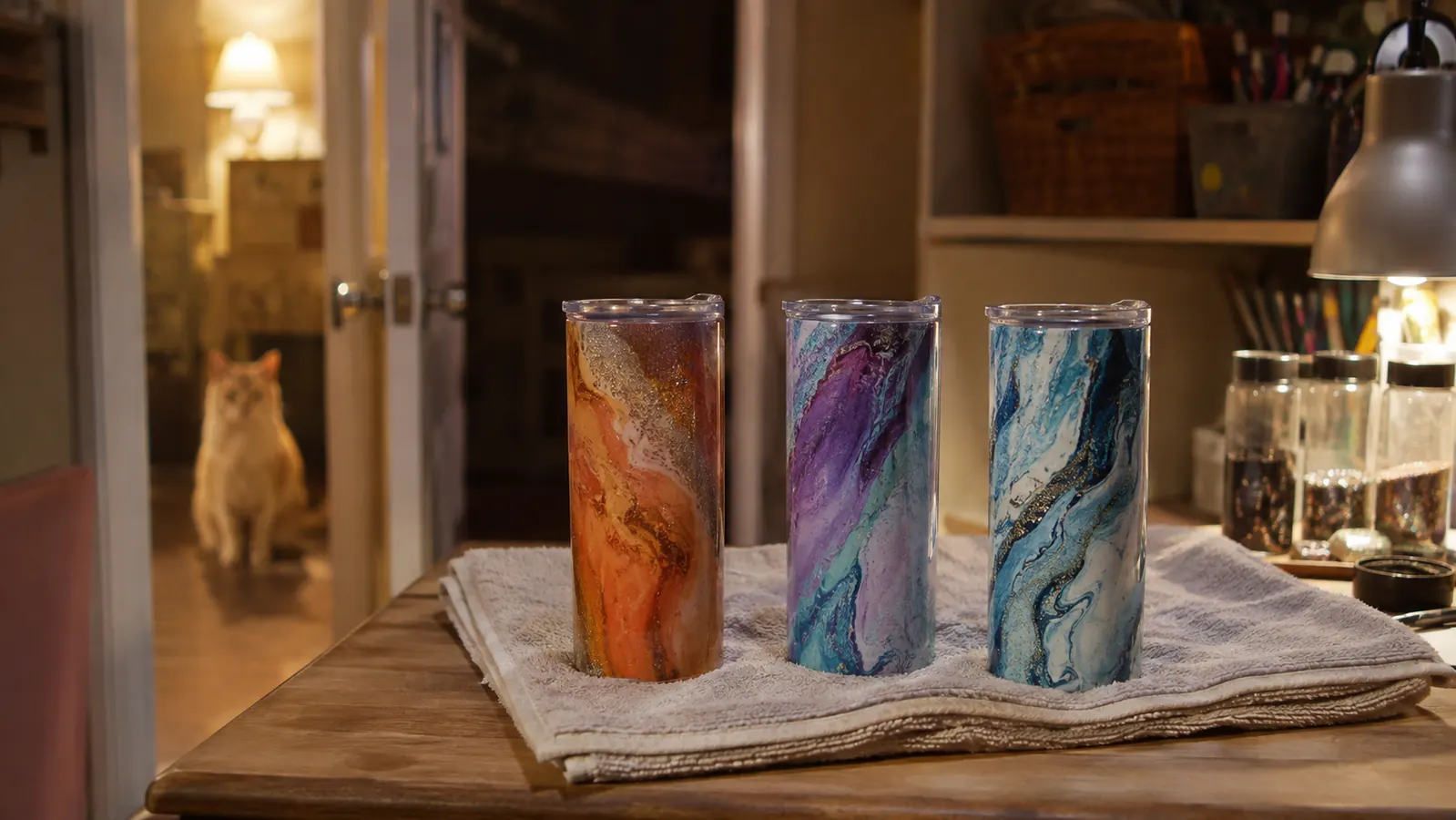
The batch that finally convinced me was four tumblers in a row, all the same blank, all the same wrap, pressed back to back without touching a setting. All four came out even, edge to edge, no seam, no ghost band. In the oven I had gotten exactly one clean tumbler out of five. That four in a row is what a consistent pressure pad buys you, and it is the whole reason I stopped dreading tumbler orders.
What It Doesn't Do
It does not wrap the blank for you, and it does not know anything about a blank you have never used before. The press holds a temperature and a pressure. Everything upstream of that is still your hands and your eyes. If the wrap has a wrinkle, you will get a wrinkle. If you skipped the test, you will find out in front of somebody. I say that as a woman who found out in front of somebody.
It also does not fold down and disappear. It is a single-purpose machine that occupies a permanent corner of a table, and if your craft space is the dining room, you need to think honestly about that before you buy. And it gets hot, genuinely hot, hot enough that I treat it like the stove. Kids out of the room. Cat out of the room. Fan on. Never unattended. That is not a warning label talking, that is me after ten months of owning one.
What I Liked
- The pad presses with the same pressure on the first tumbler and the tenth, which is what ended my ghost bands and seam lines
- The R button halts heating and releases the heat pad instantly, so I am not wrestling a hot blank out of a closed press
- 2.9 to 3.2 inch diameter and 280ml to 850ml capacity covers the 20 oz skinny tumblers I use most and the bigger bottles friends bring over
- 12.9 by 10.9 by 6.3 inches and 4.84 kg sits solidly on one end of a six-foot table without creeping on the mat
- Ten months of regular hobby use and the pad has not sagged, torn or lost its grip
Where It Falls Short
- Drinkware only, so shirts and totes still need the clamshell press on the other end of the table
- You still have to wrap the blank correctly, and a wrinkled or over-wide wrap ruins the tumbler no matter what the press does
- The surface runs hot enough that it needs a clear table and a firm house rule about grandkids and the cat
- It occupies permanent table space and it is not a light machine to move around
Four tumblers in a row came out even, edge to edge, no seam and no ghost band. In the oven I had gotten exactly one clean tumbler out of five.
Who This Is For
This is for the person who has already made a few tumblers and is tired of the oven and the shrink wrap. If you are pressing 20 oz skinny tumblers for family, for a church event, for a team banquet, and you have had two or three come out ghosted and wanted to quit, this machine solves the part of the problem that is actually solvable. It also suits someone who likes a repeatable process. Once I had my blank tested, I could press a batch without thinking hard, and that is worth a great deal when you are making twelve of something for a fall festival.
It also fits a small space better than I expected. One end of Ray's table, a heat-resistant mat, a window and a fan. That is the whole setup. I did not need a shed or a garage bay or a second table.
Who Should Skip It
If you make two tumblers a year for your own kitchen cabinet, this is a lot of machine and a lot of table for two tumblers. The oven method is imperfect but it is nearly free, and honestly, for two a year I would live with the imperfect.
Skip it too if your work is mostly shirts and tote bags with the occasional tumbler on the side. A clamshell press does the flat work and you would be buying a second machine for a job you do rarely. And skip it if you do not have a spot where you can open a window, run a fan, and keep children and pets out of the room while it is hot. Those are not optional conditions in my house and I would not treat them as optional in yours.
Ten months in, this is still the machine I turn to first
If the oven and the shrink wrap have already cost you a few blanks, the HTVRONT Auto Tumbler Heat Press is the piece of equipment that ended that for me. Same pressure every time, the pad releases the instant you press R, and it fits the 20 oz skinny tumblers I make most. Start with your blank maker's numbers and run one test. That is the whole method.
Amazon Check Today's Price on Amazon →