
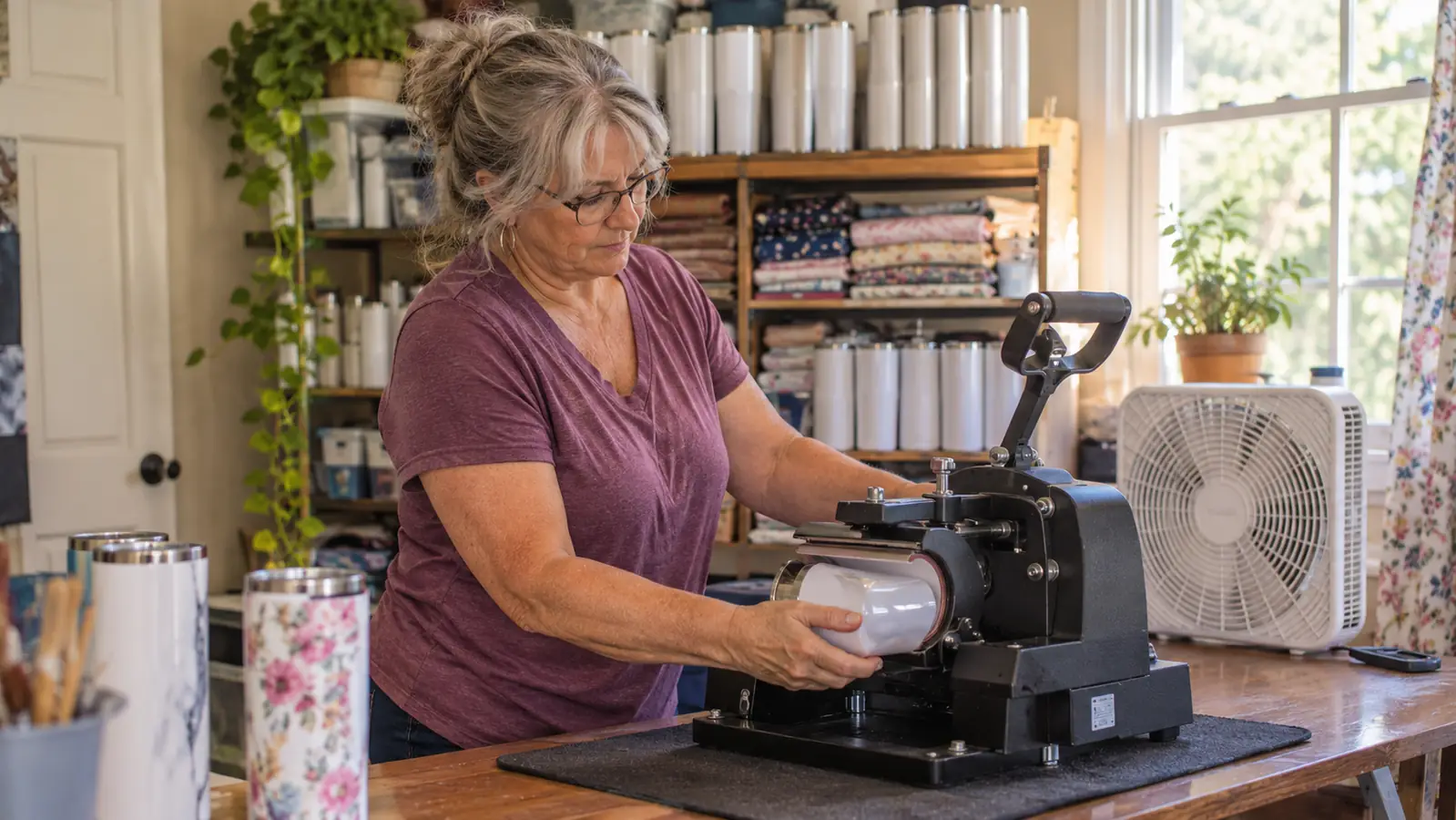
Short answer: if you have never pressed a tumbler before and you want the machine to hold the pressure instead of your wrist, the HTVRONT Auto Tumbler Heat Press is the easier place to start. Mine arrived in January 2026. Before that, I spent November and December of 2025 sublimating 20 oz skinnies in my kitchen oven with shrink wrap, and several of them came out ghosted or with a seam line running down one side. The difference between those tumblers and the ones I make now is not the paper and it is not the design. It is that the press closes on the blank and keeps holding it, the same way, for the whole time.
None of that makes the PYD Life a bad machine. It is a manual press, and manual is not a dirty word. You load the tumbler, you tighten the clamp by hand, and you watch it. As far as I can tell from the listings, most PYD Life models also come with swappable attachments, which matters a great deal if you press mugs and water bottles as well as skinnies. I do not own one. One of the women in my church craft group does, and I have stood at her table and watched her load it while we talked about her grandson. So everything below is ten months of my own use with the HTVRONT, set against what I have seen her do and what both listings actually say.
| HTVRONT Auto Tumbler Press | PYD Life Tumbler Press | |
|---|---|---|
| How it closes | One button, the motor draws the pad in and holds it | A clamp you tighten by hand |
| Blank sizes | 2.9 to 3.2 inches in diameter, 280 ml to 850 ml | Swappable attachments for mugs, bottles and several tumbler sizes |
| Stopping mid press | The R button halts heating and releases the pad at once | Loosen the clamp by hand while the element stays hot |
| Tumbler one versus tumbler forty | The motor closes to the same point every time | Depends on how tight you cranked it that afternoon |
| Mugs and odd shapes | Whatever fits inside the fixed diameter range | Dedicated mug and bottle attachments in most kits |
| What can fail on it | A motor and a control board besides the heating element | A clamp and an element, very little else |
| First week | Pick a temperature, pick a time, press the button | Learn the clamp by feel as you go |
| Bench space | 12.9 by 10.9 by 6.3 inches | A similar footprint, and the attachments live in their own box |
Why I'm the One Answering This
I am 61. I retired after 28 years as a school cafeteria manager, and I live in Visalia, California, with my husband Ray. Ray built the six foot table in our spare bedroom that everything sits on, and he is the one who lifts boxes, because I have learned not to. I started heat pressing in January 2025 with a household iron and iron on vinyl I cut out with scissors for my grandson Mason's Little League shirts. The letters peeled off inside three washes and my hands ached from the scissors. That is the whole reason I bought real equipment, one piece at a time, over the following year.
The tumbler press was the last piece, not the first. A Cricut Explore Air 2 in February 2025, a 15x15 clamshell that April, a sublimation printer in September 2025, and the HTVRONT in January 2026. These days I make shirts, tote bags, 20 oz skinnies, coffee mugs and the occasional pillow cover for family, for our church's fall festival and for two or three small craft fairs a year. I am a hobbyist with a good table and a patient husband, not a print shop, and I want to be clear about that before I tell anyone what to buy.
What the First Week Actually Feels Like
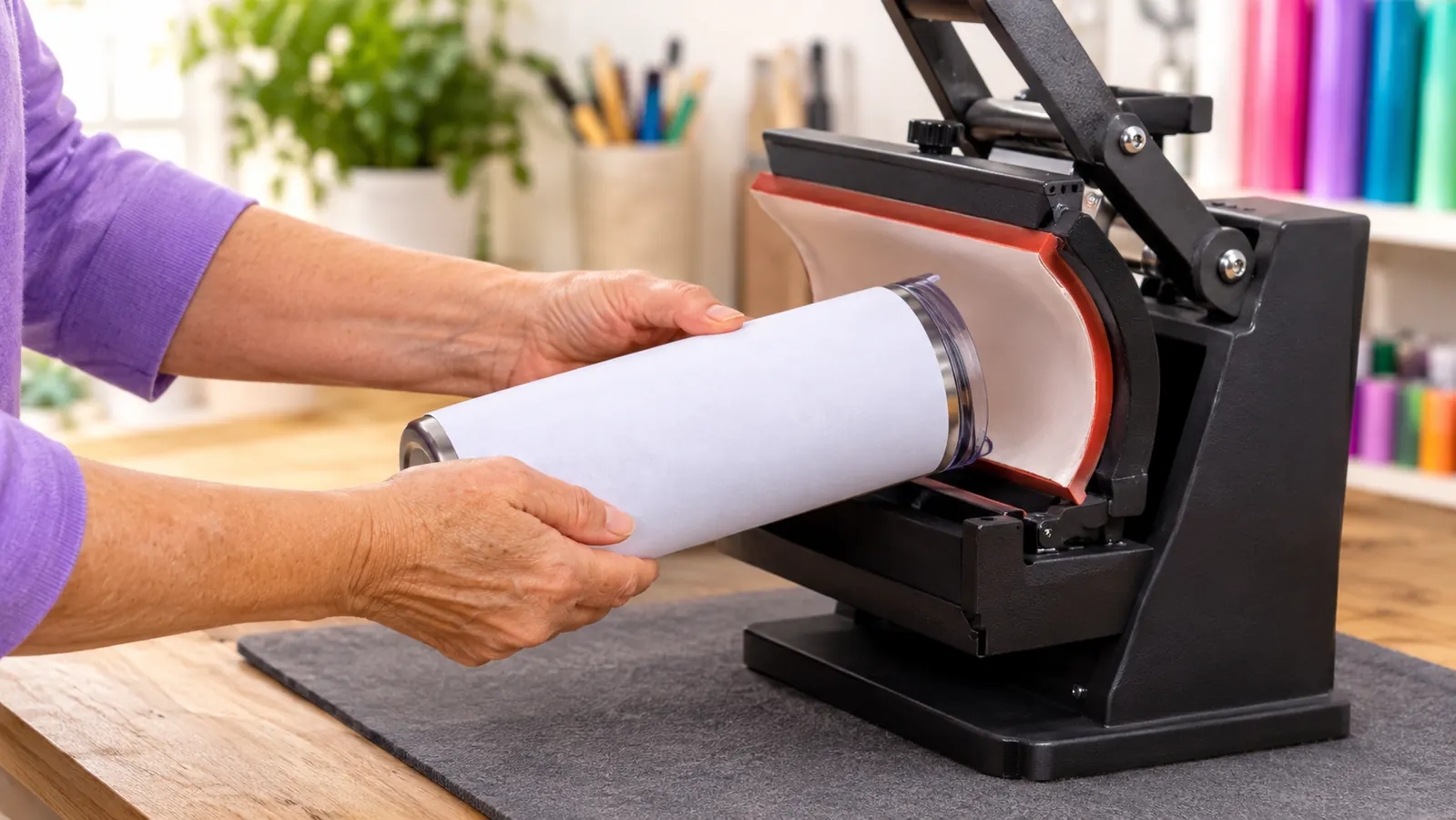
With the HTVRONT you press one button and the motor draws the heat pad in around the tumbler. There is no clamp to crank and no feel to develop. That sounds like a small thing until you are eight tumblers into an evening, or until your hands are like mine and the grip is not what it was at 40. The press takes tumblers from 2.9 inches to 3.2 inches in diameter, which covers the skinnies I buy, and blanks from 280 ml to 850 ml. Anything inside that range goes in the same way, and I can step back while it runs and get the next wrap ready instead of standing over it.
There is also an R button. Press it and the machine stops heating and releases the heat pad right away. On a manual press, if a wrap slips or a tumbler starts to turn, you are loosening a clamp by hand with the element still sitting there and still hot. I have used that R button twice in ten months, both times because a wrap slid off the top edge, and both times the tumbler was still usable once I re-wrapped it. That is not a feature I would have thought to want. It is one I would not give up now.
The first week is a small amount of learning either way. Mine went like this: read the blank maker's numbers, pick one tumbler I could afford to lose, run it, look at it. If it is ghosted, add a little time. If the design is blown out and soft at the edges, back the temperature down. The machine's range runs from 210 °F up to 390 °F, so there is room to move in both directions. What you are not learning in that first week with the HTVRONT is pressure, because the machine sets that for you and holds it.
The press does not care whether I am having a good day. Same pressure, same time, same tumbler, every time. That was the part I could never get out of an oven and a pair of oven mitts.
Where HTVRONT Wins
Consistency is the entire argument, and it is not a marketing point, it is a Tuesday night point. A motorized press closes to the same place on tumbler one and tumbler fifty. A clamp you tighten by hand is only as even as your grip on that particular day, and after an hour of pressing my grip is not what it was when I started. If I am making six tumblers for a church event, I do not want the sixth one to be the one with a faint band around it that I have to explain.
The second win is that it is basically one decision repeated. Temperature, time, press. I set the numbers once for a batch, write them in my notebook, and I am done fiddling with anything until the next batch. It is also small enough to live in a spare bedroom: 12.9 inches long, 10.9 inches wide and 6.3 inches high, at 4.84 kg, which means Ray carries it to the shelf and I do not. The shell is ABS, it carries a one year warranty, and the exterior gets warm but not hot enough to frighten me. I still keep my hand off it.
Where PYD Life Wins
Attachments. As far as I can tell from the listings, most PYD Life presses ship with swappable sleeves, so a mug, a water bottle and a wider tumbler each get the right size instead of being squeezed into one fixed opening. My HTVRONT covers 2.9 to 3.2 inches, and if a blank falls outside that number then it falls outside that number. Some do. If I were pressing mugs every week instead of once a month, or if friends kept handing me whatever cup they had in the cabinet, I would be looking much harder at the press that changes shape to match the blank.
The other PYD Life point is honest and a little boring: there is less to break. A manual press is a clamp and a heating element. My HTVRONT has a motor and a control board in it besides the element, and those are two more things that can fail inside the one year warranty or after it. I have not had a single problem with mine, and 2,445 ratings averaging 4.5 stars suggests most people do not, but I am not going to pretend the manual design does not have fewer parts in it. Fewer parts is worth something, especially to someone who does not want to ship a machine back.
If you would rather the press held the pressure than your hand
The HTVRONT Auto Tumbler Press closes on the blank with one button, releases the pad with the R button when something slips, and takes 20 oz skinnies and blanks from 280 ml to 850 ml. It is the machine I would set in front of a beginner at my own table, and it is the one that is still sitting on Ray's table in November.
Amazon Check Today's Price on Amazon →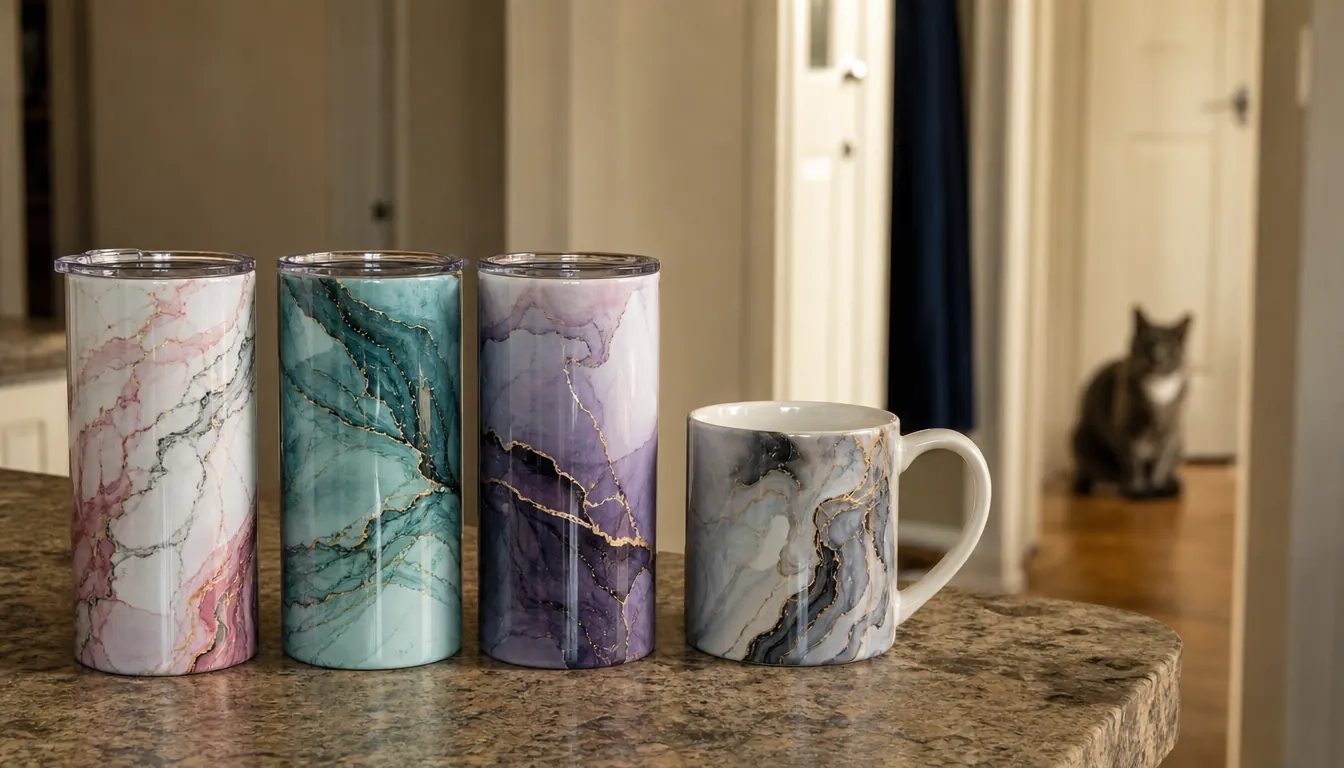
The Question I Get Asked Most
The question is always the same one: do I need the auto press, or is the clamp fine? My honest answer is that the clamp is fine if you are patient and your hands are good. Mine are not great. I have arthritis in my right thumb from 28 years of opening cans and lifting trays, and cranking a clamp a dozen times in an afternoon is not how I want to spend a Saturday I am supposed to enjoy. That is a personal reason, not a technical one, and I know the difference.
The technical reason is the batch. If you press one tumbler a month, a manual press will do the job and do it well. If you press eight for a church fall festival on a Thursday night because the festival is Saturday, you want the machine that repeats itself without you. My first oven batch had four tumblers in it and two were usable. My last press batch had eight and all eight were usable, and I did not have to stand over any of them with a stopwatch in one hand and an oven mitt on the other.
The Settings and the Tumbler I Wrecked
The first tumbler I wrecked on the press was not the press's fault. I had a wrap that was loose at the top, I did not tape the seam, and the pad pulled it sideways as it closed. That is the one that taught me to tape the seam and run my thumb around the top edge before I press the button. The second lesson was temperature. I started too hot because I assumed hotter meant faster, and the design came out soft and blurry at the edges, which is a mistake you only make once with a blank you cared about.
What I do now, every single time: the blank maker's recommended time and temperature first, then one test tumbler I can afford to lose, then adjust in small steps. I keep a notebook with the numbers for each blank I buy, because the second time I order that same tumbler I do not want to solve the puzzle again. If the craft room is cold in the morning, I give the press a few extra minutes to come up to temperature before the first press, and I check that with a test rather than by guessing.
I do mugs too, and I treat them exactly the same way. Blank maker's numbers, one test mug, adjust from there, and look at the handle clearance before anything else because that is where my first one went wrong. Small blanks have less room for error than a 20 oz skinny, so the test is not optional for me. If you only take one habit from this article, take that one.
Two things I will not skip. First, ventilation. My craft room is the spare bedroom, so the window is propped open and a small box fan sits on the corner of Ray's table moving air out of the room whenever the press is on. Second, the press is never left running when I leave the room, not for a phone call and not for the doorbell. Pepper, our cat, is shut out of the craft room whenever the press is hot. Mason and Lily are not allowed to touch it, full stop, and they know why. The shell gets warm and the pad gets a great deal warmer than warm.
Who Should Buy Which
Buy the HTVRONT if you are where I was in December 2025: pressing 20 oz skinnies for family and friends, working alone, wanting one less thing to think about while you learn. It suits a beginner because the pressure decision is gone. It suits hands like mine because there is no clamp to fight. If your blanks all land inside the 2.9 to 3.2 inch range and you press in batches, this is the machine I would put on your table, and it is the one I would buy again with my own money.
Look hard at the PYD Life instead if your blanks are all over the map. Mugs, bottles, wider tumblers, whatever the order happens to be. Swappable attachments earn their keep when you change blank types every week, and a manual clamp lets you feel the pressure yourself instead of trusting a motor. If you already press shirts on a manual clamshell and you like working by feel, a manual tumbler press will feel familiar rather than fussy. Check both listings for what is actually in the box, because the attachments change from model to model, and check the current price at the same time since that moves too.
The press I would hand a beginner at my own table
Ten months, a lot of tumblers, one wrecked blank that was entirely my own fault. The HTVRONT Auto Tumbler Press is still on Ray's table and still closing on the blank with the same pressure it did in January. One button in, one R button out, and the rest is your design.
Amazon See the HTVRONT Auto Tumbler Press on Amazon →