The first tumbler I ever sublimated came out of my kitchen oven looking like a message from a ghost. The design was there, sort of, faded in the middle and crisp at the edges, with a faint seam line running down one side where the shrink wrap had wrinkled. I had done everything a video told me to do. I had wrapped it tight, I had timed it, I had crossed my fingers. Two out of the five I made that November evening in 2025 were bad enough that I did not give them to anyone.
That is the reason I bought the HTVRONT Auto Tumbler Heat Press in January 2026. Not because I wanted another machine in the spare bedroom, which is now so full I have to turn sideways to reach my scissors. Because I wanted the wraps to stop looking like accidents. Ten months later, I can tell you what this press does well, what it does not, and the three things I got wrong at the start that cost me a handful of blanks.
The Quick Verdict
A genuinely good tumbler press for a hobbyist, once you accept that the machine is the easy part and the wrapping is the skill. I would buy it again, and I would read the diameter range before I did.
Amazon Check Today's Price →Ten months in and it is still on my table, not in a closet
If you are tired of oven wraps and shrink sleeves that ghost halfway up the design, this is the tool that ended that for me. Check the current listing to confirm it fits your tumbler diameter before you order.
Amazon Check Today's Price on Amazon →How I've Actually Used It
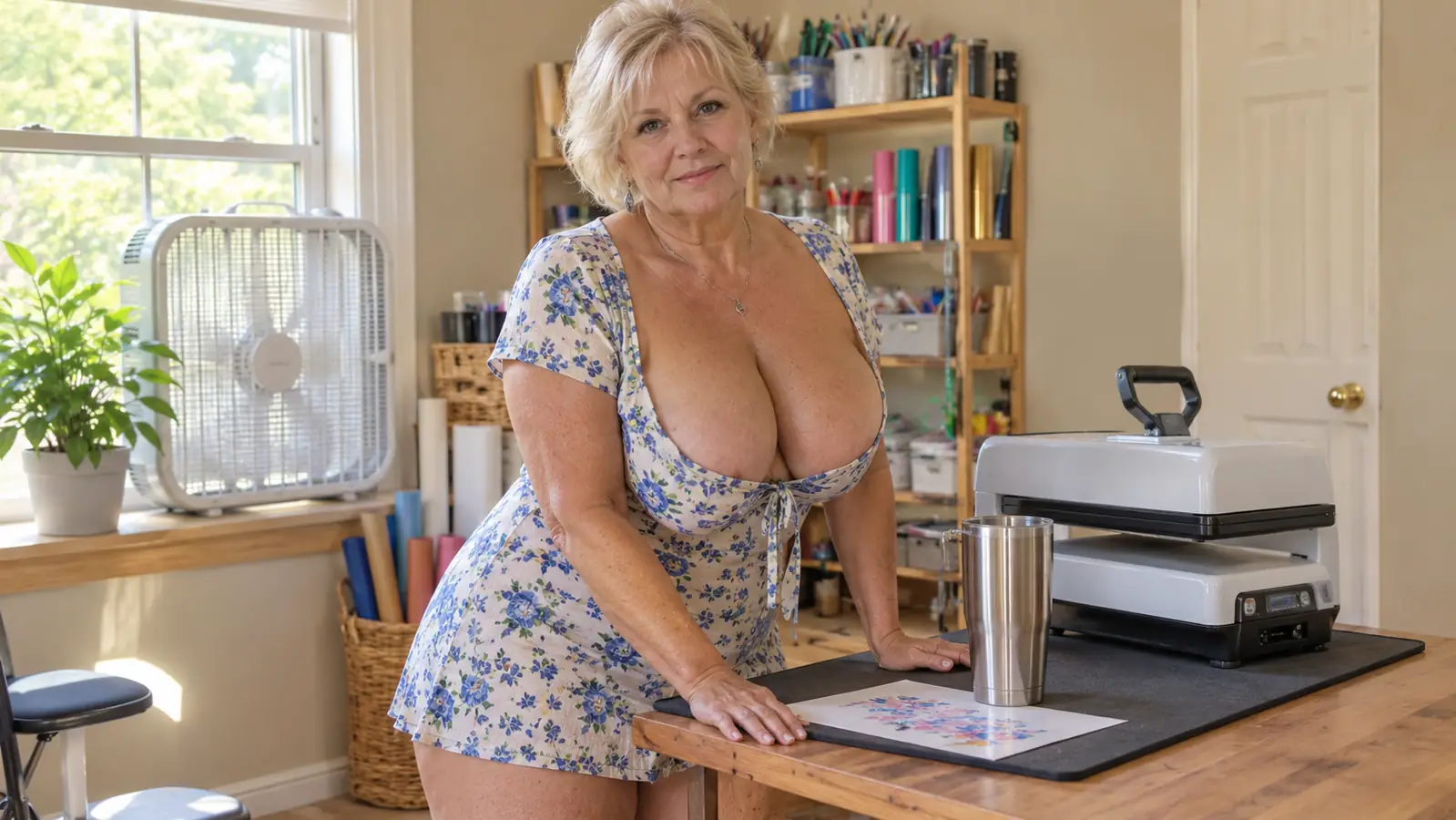
The machine itself is straightforward. It is a compact unit that sits on Ray's table on a heat-resistant mat, and it warms up to the point where I can start working in a few minutes. The temperature range on this press runs from 210 °F up to 390 °F, which covers everything I do. It holds a tumbler between 2.9 inches and 3.2 inches in diameter and takes blanks from 280ml up to 850ml, and I can confirm that 20 oz skinny tumblers sit right in the middle of that range, which is most of what I make.
What I like most is what the listing leads with. Once the tumbler is in and the pad is closed, the press does the pressing. I am not standing there leaning on a handle for four minutes at a time counting in my head. When I want to stop, for any reason at all, I press the R button and the machine halts the heat and releases the pad immediately. That matters more than it sounds like it matters. With a sublimation wrap, those extra seconds while you fumble with a latch are seconds your design is still cooking.
I keep a spiral notebook beside the press, and it is the only reason I know anything. A Saturday in March, I did six tumblers for our church's spring lunch. Six in one sitting on the HTVRONT, which I would never have attempted in the oven. I trimmed and taped all six wraps the night before at the kitchen counter while Ray watched a ballgame, so the morning was just load, close, wait, release, set aside. Two hours, start to finish, including warm-up and wiping the blanks down with alcohol first. In the oven days that same six would have eaten two evenings and I would have lost one of them.
I use it for tumblers almost exclusively. The listing says it handles mugs, water bottles and other drinkware of a similar shape, and I do not doubt it, but I am not going to sit here and describe settings I have not spent real time with. What I can tell you is what changed for me: no more shrink sleeves, no more oven, no more arguing with my kitchen about smells.
Where the Learning Curve Actually Is
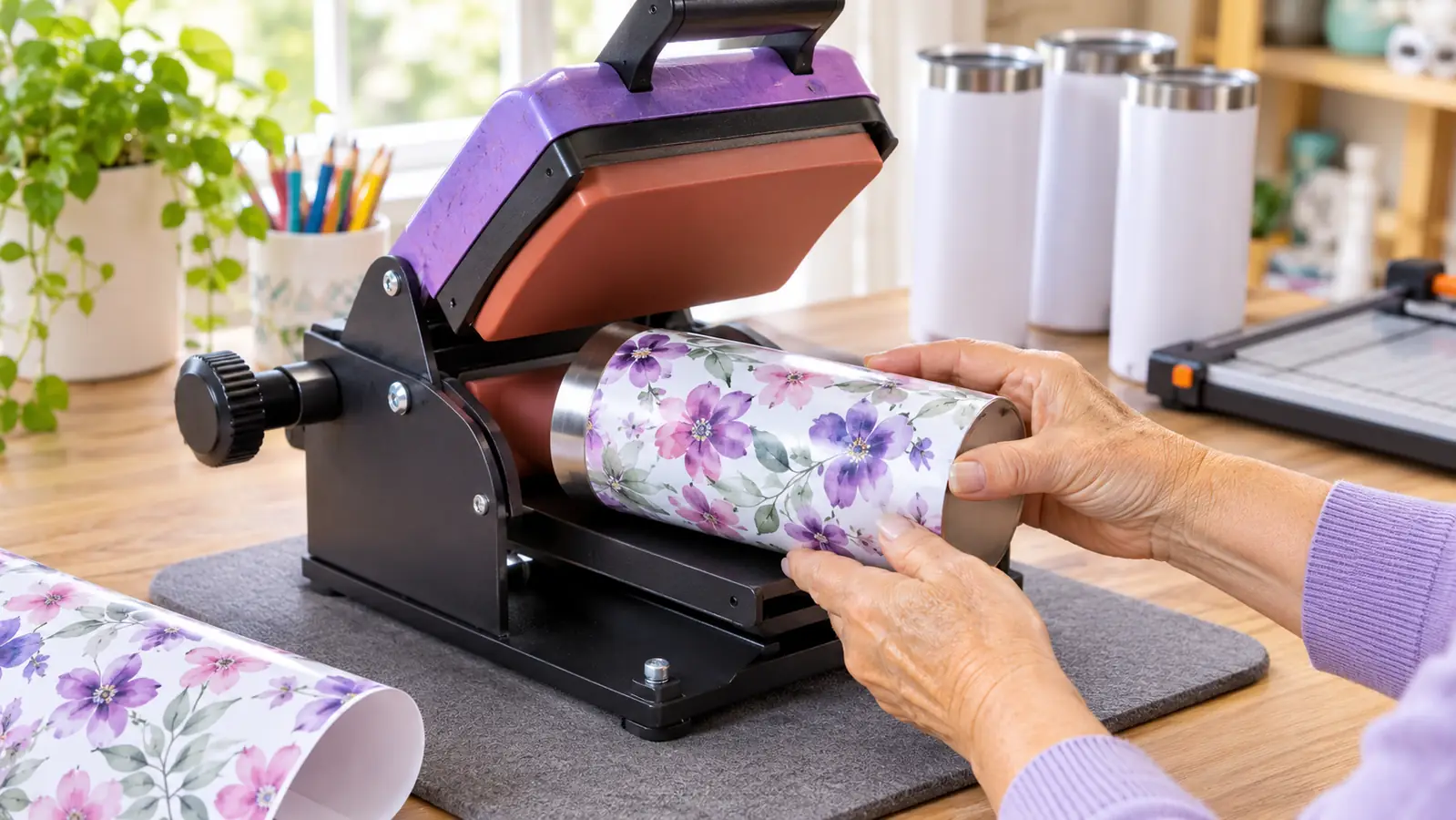
Here is the thing nobody puts in the listing photos. The press is a heater. The design quality comes from the wrap, and the wrap is a hand skill. My first three tumblers on this machine were better than my oven ones and still not good. One had a faint ghost on one side because the paper had shifted a hair when I closed the pad. One had a pale band near the bottom because I had trimmed the paper a quarter inch too short. The machine did exactly what it was told.
What fixed it for me was slowing down at the wrap step. Tape the paper seam. Roll the tumbler on the table with pressure, both directions, before it ever goes near the press. Trim with an actual trimmer, not kitchen scissors, and trim generously and then trim again. I use A-SUB sublimation paper, 8.5 by 11, and I have reordered it several times since October 2025, so that part of my setup has been stable while I learned.
The wrap mistake that cost me the most was paper length. I was trimming to the printed edge of the paper instead of to the tumbler, and the bottom half inch of every design sat about a sixteenth of an inch low. It took me four tumblers to notice, because the design I was using had a dark border along the bottom and the gap disappeared right into it. When I switched to a design with a pale background, the miss was obvious from across the room. Now I lay the trimmed sheet on the tumbler dry, roll it once, and look at where the far edge lands before I tape anything down.
The other part of the curve is temperature and time. I am deliberately not going to hand you a number and tell you it is correct, because it depends on your blank, your paper and your printer. Start with the blank maker's recommended time and temperature, then do a test tumbler that you are willing to throw away. Write down what you used. That notebook beside my press is the single most useful thing in the room.
The machine is a heater. The design quality comes from the wrap, and the wrap is a hand skill.
The Things I'd Change
The diameter window is the real limitation and it is the one I would want a new buyer to hear about first. 2.9 to 3.2 inches is not a wide band. It fits a 20 oz skinny tumbler comfortably and it fits the mugs and bottles that match that profile, but if you have your eye on a fat, squat tumbler or a very slim one, measure it before you order. I did not, the first time I looked at this listing, and I got lucky.
Second, this is a countertop appliance, not a shop machine. The shell is ABS, and the whole thing is small enough to move with one hand. I like that, because it lives in a spare bedroom and I have to pack it up for church events. But it means you should think of it as a tool that needs a stable table, not something you can toss in the trunk on its side. Ray built my table and it does not wobble, and I would not want to press on anything that does.
The other thing I would change is not about the press at all. It is about the table. The unit is small enough that I set it up at the very front edge of Ray's table at first, so I could reach the release without stretching, and that hung the hot pad out over open air. One afternoon I set a finished tumbler down beside it and watched the flat sheet of paper I had laid out start to curl from the heat rolling off the side. Now the press sits square in the middle, finished pieces go on a folded towel to the right, and trimmed paper stays to the left, well clear. Reorganizing three feet of tabletop fixed more problems than any setting change I made.
Third, and this is more about the whole category than this press: heat is heat. I open the window, I run a small box fan, and I do not leave the room while it is hot. Pepper, my gray tabby, is shut out of the craft room the entire time the press is on, and the grandkids do not touch it, ever. If you take nothing else from this review, take that. A machine that reaches 390 °F is not a toy, and the release button is convenient, but it is not a safety system.
What Nobody Tells You About Tumbler Presses
The honest version is that this press mostly removed the part of the hobby I hated. With the oven, every tumbler was a small gamble, and the failure mode was always the same: ghosting in the middle, a seam line, or a design that faded before it hit the edges. With a press that closes around the blank and holds it, the heat is applied evenly and I stopped seeing that specific failure.
But it did not make me a printer. I still get a bad wrap maybe one in ten, and it is always my fault, always something I rushed. The women in my church craft group who do tumblers have the same story. One of them uses a different brand of press entirely and says the same thing, that the machine is not the hard part. I have never owned another tumbler press, so I cannot tell you this one beats a competitor on the bench. I can tell you what I have seen at craft fairs, which is that the people with clean tumblers are the ones who wrap slowly, not the ones with the fanciest equipment.
Something else worth knowing: the press fits a narrow band of blanks, so my whole shelf of tumblers got sorted. I measured every blank in the house with a ruler one evening, wrote the size on the bottom of each one with a marker, and moved the ones outside the range to a different shelf in the closet. It sounds fussy. It saved me from reaching for the wrong tumbler on a Sunday morning when I was trying to get four done before church. If you buy the HTVRONT press, do the measuring first, in one sitting, before your first project, because the middle of a project is the worst possible time to find out.
One more thing. The listing says the press halts heating and releases the pad instantly on the R button, and that is accurate, but read it for what it is. It is a stop, not a pause. If you hit it too early, you are done with that press cycle. I did that twice early on because I was nervous about the time, and both tumblers went in the bin.
Setup, Ventilation, and the Boring Safety Part
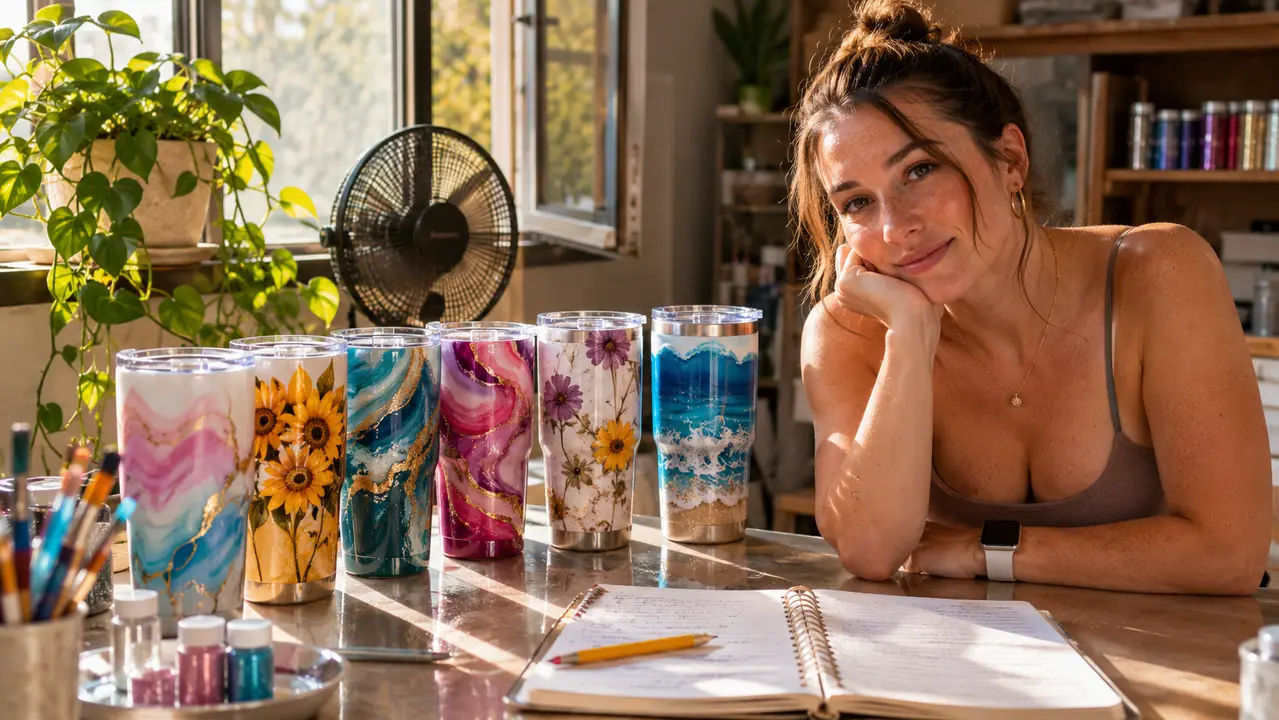
My craft room is the spare bedroom. The press sits on the six-foot table Ray built, on a heat-resistant mat, with the window on my left and a small box fan pulling air across the work area. I open that window every single time, even in January, even for one tumbler. Sublimation puts off a smell you do not want to sit in, and the fan is cheap. There is no reason not to.
The machine is 12.9 inches long, 10.9 inches wide and 6.3 inches tall, and it weighs about 4.84 kilograms, which I looked up because Ray asked me how heavy the box was going to be. He carried it in. It runs on standard 120 volt household current at 600 watts, so it is not doing anything dramatic to your outlet, but I still do not run it on the same strip as anything else in that room. There is a one-year warranty listed, and I have not had to use it.
If you are new to this, the setup order I would give you is: mat down, window open, fan on, press warmed up, blanks and paper laid out and trimmed before you turn anything on. Doing the trimming while the press is hot is how you end up rushing the wrap.
What I Liked
- The press holds and applies heat on its own, so I am not leaning on a handle for four minutes at a time
- The R button halts heating and releases the heat pad immediately, which saves a design that is at its limit
- Fits 20 oz skinny tumblers cleanly, and the 210 °F to 390 °F range covers everything I make
- Small enough to live on a spare-bedroom table and to pack up for a church event
- Ten months of regular use and it has not given me a single mechanical problem
Where It Falls Short
- The 2.9 to 3.2 inch diameter window is narrow, so measure your blank before you order
- It does not fix a bad wrap, and the wrap is where the results actually come from
- The stop button is a stop, not a pause, and hitting it early wastes the blank
- Like every press it gets genuinely hot, so a ventilated room and a closed door for pets and kids are not optional
Who This Is For
If you are where I was in December 2025, doing tumblers in the oven with shrink wrap and getting a ghosted one every batch, this press will end that specific frustration and you will be glad you bought it. It suits someone making a handful of tumblers at a time for family, friends, a team, or a church fall festival, on a table in a spare room, with a real window nearby. That is exactly my situation and it has fit it well for ten months.
It also suits someone who is willing to be bad at it for a few weeks. I ruined a few blanks. I would rather tell you that than pretend I unwrapped a perfect tumbler on day one. The press is forgiving on heat and unforgiving on technique, and if you go slow at the wrapping step, it rewards you.
Who Should Skip It
Skip it if your tumblers are outside the 2.9 to 3.2 inch diameter range or bigger than 850ml. Measure first, honestly, with a ruler, before you spend anything. I have watched people buy a press and then discover their blanks do not fit, and it is a miserable way to start.
Skip it if you want a machine that replaces the skill. This one does not. You still have to learn your blank, your paper and your printer, and you still have to wrap carefully every single time. And skip it if you cannot give it a ventilated spot away from children and pets, because a press that reaches 390 °F in a closed bedroom is a bad idea no matter how good the price is.
Last thing, and then I will let you go. I do not sell tumblers for a living and I never will. I make them for my grandkids' teams, for church, for a couple of craft fairs a year, and for the women in my craft group who ask. That is the whole of it. What I can tell you after ten months is that the HTVRONT Auto Tumbler Heat Press took the gambling out of my tumbler evenings, and the rest was me, learning to slow down.
The machine stopped my ghosted tumblers. The rest was me, learning to wrap slower
Check the diameter range against your blanks first, then check today's price. Ten months of regular use on my table and it is still the tool I reach for.
Amazon Check Today's Price on Amazon →