The first pack of A-SUB sublimation paper landed on my porch in October 2025, a month after the Epson SureColor F170 took over the corner of my craft room. By then I had already thrown away a few blanks on the sample sheets that shipped with the printer and on a cheap pack I grabbed off a clearance shelf at a craft store, which bled so badly that the first tumbler I ever wrapped came out looking like a bruise. So I was not in a generous mood when I cut the tape on that box. Thirteen months and several reorders later, I know what this paper does well and exactly where it will bite you, and that is what this is.
The short version, which is not the version on the listing: A-SUB is good paper for the way most of us actually work. It transfers bright and even onto white polyester, it feeds through the printer without drama most days, and 110 sheets lasts me months when I am pressing for Mason's team, for Lily's class, for the church fall festival and for two or three small craft fairs. But nobody mentions the curl. Nobody mentions the coated side. And nobody mentions what a Central Valley summer does to the last fifteen sheets in an open package. Those three things are most of this review.
The Quick Verdict
Bright, repeatable transfers on white polyester, tile and metal, with a curl and an unmarked back you have to work around. Good paper for a hobbyist. Not paper that forgives sloppy storage.
Amazon Check Today's Price →Good paper, one coated side, and a curl you have to plan for
110 sheets of 8.5 by 11, even color on white polyester and light blends, and the same behavior pack after pack. Read the part about the coated side before your first sheet, not after your second ruined blank.
Amazon Check Today's Price on Amazon →How I Use It, and What I Ruined First
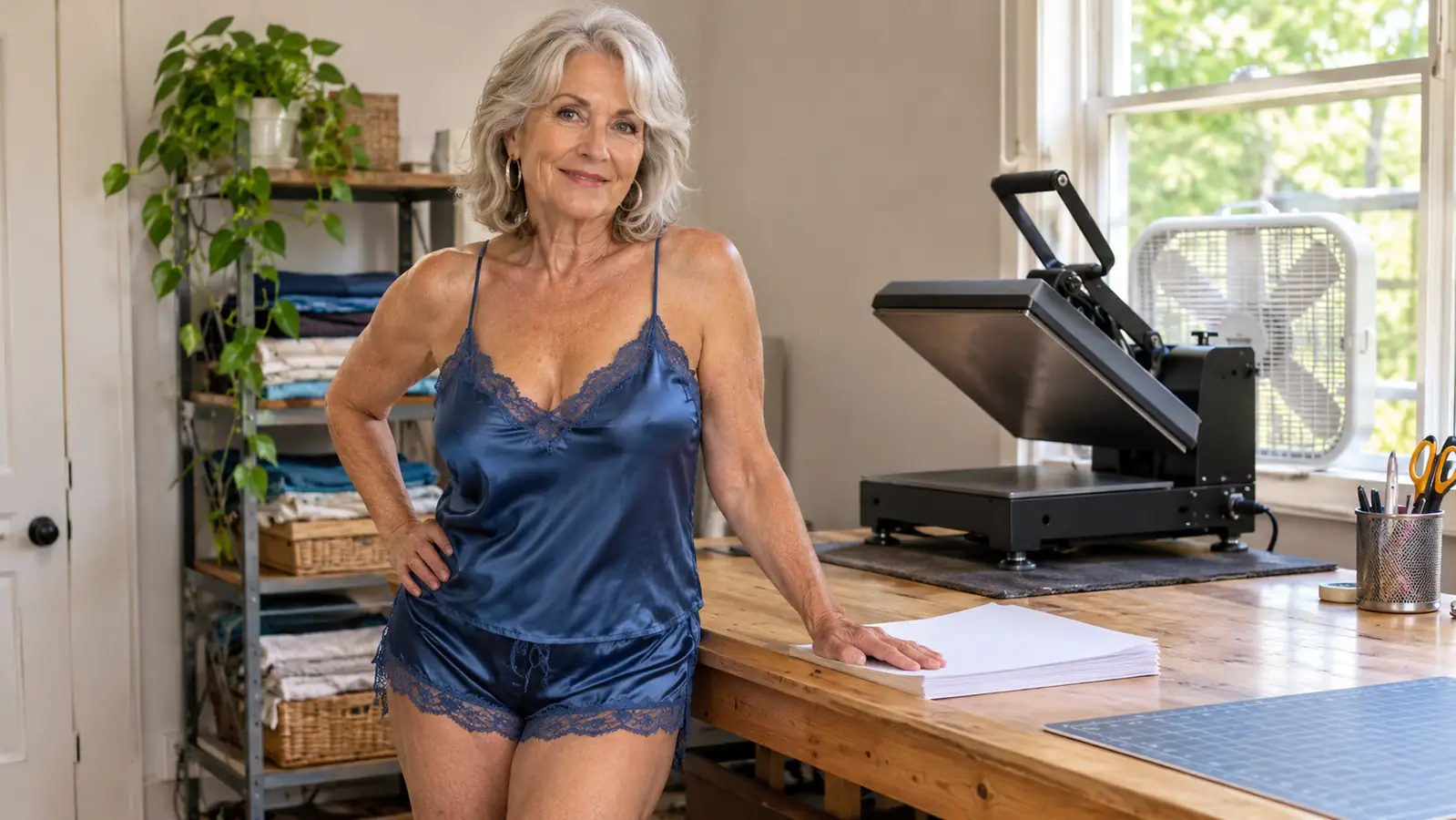
My setup is not a print shop and I am not going to pretend it is. Ray built me a sturdy six-foot table in the spare bedroom, the Fancierstudio press sits on a heat-resistant mat at one end, and the printer lives on a small cart beside it. I open the window and run a small box fan the whole time the press is on, and Pepper, our gray tabby, gets shut out of that room while the platen is hot. If you are pressing in a bedroom or a garage, do the same, and never walk away from a hot press. That part is not about paper at all, but it is the part I would say first if you were standing in my kitchen.
I bought the A-SUB pack because the printer needed paper and the clearance stuff had already cost me blanks. My first impression was honestly good. The sheets are 8.5 by 11, standard letter size, so they sit in the tray like a normal sheet of paper. The listing gives a paper weight of 120 and an item weight of 125 grams with a coated finish, and what that means in your hands is a sheet that feels slightly stiff and smooth on one face. My first press with it was a scrap of white polyester I keep for test prints, and the color came off flat and even with no blotching at the edges. I have reordered it four times since.
Over thirteen months I have run this paper through shirts, tote bags, 20 oz skinny tumblers, coffee mugs and a set of ceramic tiles I made for my sister. It handled all of them. When I moved from the oven and shrink wrap method to the HTVRONT tumbler press in January 2026, the paper was not the variable that changed. When a print came out wrong, it was almost always me: too much pressure, a blank that was not polyester enough, or a sheet loaded the wrong way up.
The Coated Side Is the Whole Ballgame
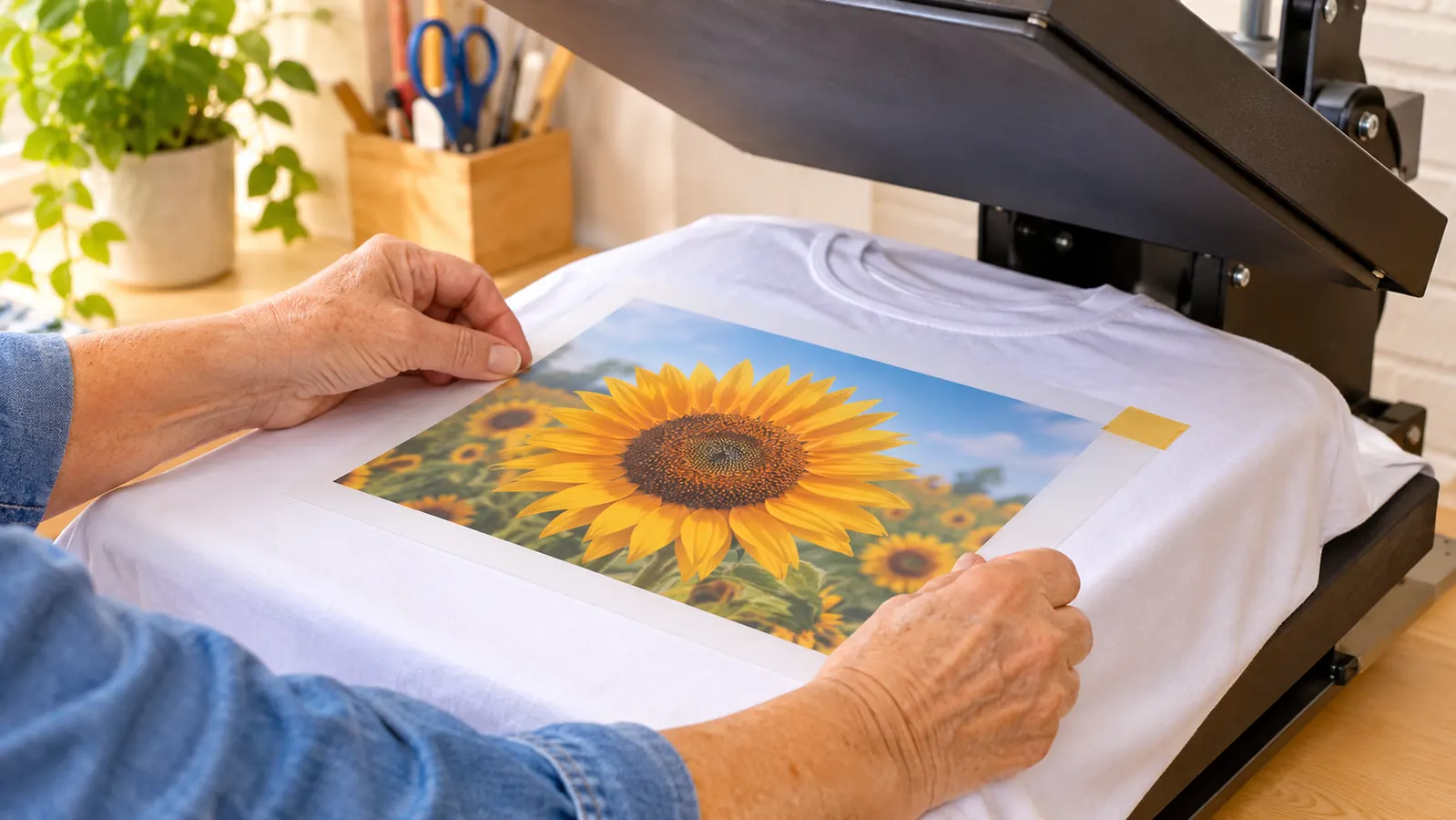
The listing says coated, and it is not being cute about it. Only one face of the sheet takes the sublimation ink. The other face will accept a print that looks perfectly fine coming out of the printer, then transfer faint and washed out, and you will spend twenty minutes convinced your print head is clogged when the print head is fine. That was my second ruined blank and my first real lesson. Now I fan the stack and feel for the smooth side before I load anything, and I keep a small pencil mark on the corner of the top sheet so I do not lose my place halfway through a run of shirts.
Here is what does not appear in the product photos: the sheets have nothing printed on the back. No logo, no arrow, no little note telling you which side is the coated one. On a fresh sheet in good light you can feel the difference, smooth against slightly rougher. On the fifteenth sheet, with the fan running and the press beeping at you, you cannot. So mark them. That one habit has saved me more blanks than any temperature change I have ever made, and it costs nothing.
The Curl Is Real, and It Gets Worse Near the Bottom
The pack arrives with a slight bow to it, and the top few sheets come out with a curl that will make a sheet-fed printer complain. I take the stack out, flex it gently the other way, and let it sit flat under a book for a few minutes while I set up the press and tape my blank down. That sounds fussy written out. It takes less time than clearing a jam, and I have cleared enough jams to know.
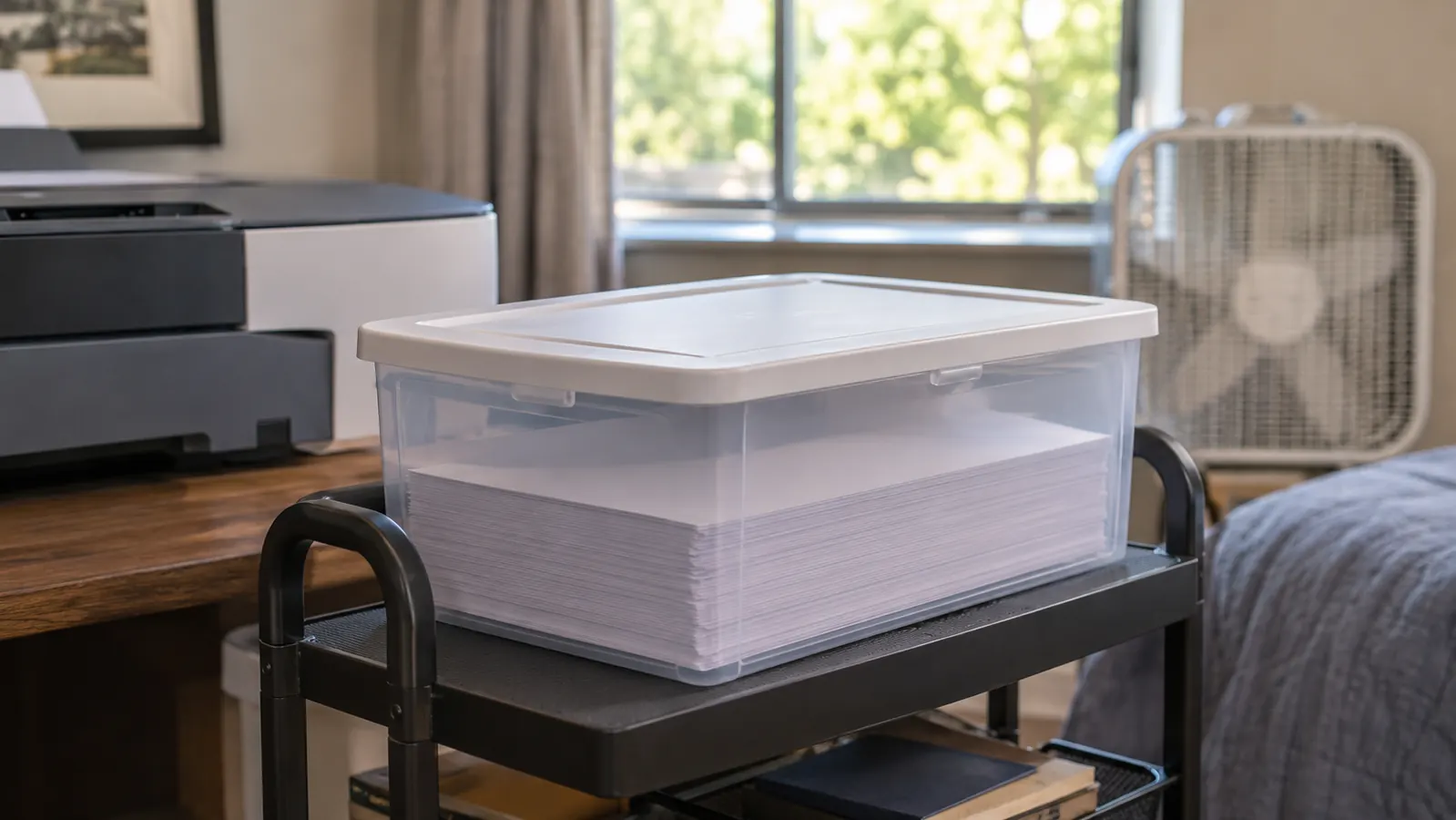
The bigger issue is storage, and this is the thing I wish someone had told me in October 2025. These are paper, and paper in Visalia in July is a different material than paper in Visalia in January. If I leave the wrapper open and the pack sitting on the cart with the window open, the edges start to lift within a couple of weeks, and the last fifteen sheets fight the printer every single time. I now keep the unused sheets in the original wrapper inside a flat plastic box with a lid, and I have not had a bad feed since I started doing that. If you live somewhere humid, or somewhere with a real summer, plan for it before you open the pack.
I want to be fair here. Curl is what happens to coated paper stored open, and I have had the same fight with paper that women in my church craft group have handed me to try. It is not something A-SUB invented. But this review should say it plainly, because the listing will not, and because a curled sheet at seven in the morning is the number one reason people decide a paper is bad when the paper is fine.
Only one side of the sheet takes the ink, and nothing on the back tells you which side that is. Mark it. That one habit has saved me more blanks than any setting I have ever changed.
What the Listing Actually Promises
The listing is specific in the ways that matter and quiet in the ways that do not. It gives you 8.5 by 11 inch sheets, 110 to a pack, a paper weight of 120, an item weight of 125 grams, and a coated finish with a high transfer rate. It says plainly that the paper works with sublimation ink only and that regular ink will not do anything. That last line is the one people skip past. If you are trying to run this through a regular inkjet with regular ink, you will get a wet sheet and a lot of confusion, and it will not be the paper's fault.
It also tells you what to press it onto: white or light colored high quality polyester, material with cotton content of 30 percent or less, ceramic and tile, phone cases and metal. I want to slow down on that, because this is where most of the disappointment in reviews like mine comes from. A shirt that is half cotton and half polyester will take a print. It will look soft and slightly faded and it will feel like a mistake. It is not a mistake. It is the paper doing exactly what it told you it would do on a blend it was never built for.
Dark blanks are their own separate conversation. This paper is made for white and light colored polyester. If you are trying to put a light design on a black shirt, you need a different approach entirely, and no amount of fiddling with time or temperature is going to fix it. I learned that on a navy tote bag that now lives in my scrap bin, and I keep it there as a reminder.
How It Behaves on Tumblers, Mugs and Tile
Tumblers are where I expected trouble, because a 20 oz skinny is a curved surface and paper does not like to curve. I wrap the printed sheet tight with heat-resistant tape, smooth from the middle outward, and accept that the seam is going to be the seam. With the tumbler press I get an even result almost every time. Back in November and December 2025, before I had that press, I was doing tumblers in the kitchen oven with shrink wrap, and several came out ghosted or with a visible line where the wrap overlapped. I blamed the paper for about a week. It was not the paper.
Mugs and tiles are the easy ones. A flat ceramic tile is the most forgiving blank I own, and a print on tile comes off this paper crisp enough that I have handed them out as gifts without any apology attached. Mugs behave the same way, flat and even with no blotching. If you are just starting out and you want one project that will make you feel like you know what you are doing, buy a few tiles and run them with this paper before you touch a shirt. Start with the blank maker's recommended time and temperature and then do a test piece, because every press runs a little different and mine is not yours.
Where It Genuinely Falls Short
Three things, and I would rather you hear them from me than find them out on your own. First, the curl and the storage sensitivity I already covered. If you are the kind of person who leaves a pack open on the table for two months, budget for a plastic box the same week you buy the paper. Second, the total lack of any marking on the sheet. For a hobbyist pack I do not expect printing on the back, but I do expect to be able to tell the sides apart in a hurry, and I cannot. Third, the sheets are not going to feel luxurious. This is a 120 paper weight and it behaves like one. It is thin enough that I handle a printed sheet by the edges before it goes onto a blank, and thick enough that I have never had one tear in the printer.
And one honest limitation that is mine and not the paper's. I press in a spare bedroom with a box fan running, which means fine paper plus moving air, and I have to be careful about dust settling on a sheet that is sitting out while I fuss with a blank. I keep the stack closed until the moment I load it. That is a workshop habit rather than a product flaw, but it is part of using this paper in a real house with a cat and a husband who comes in to ask where the tape measure went.
What I Liked
- Bright, even transfers on white polyester, ceramic, tile and metal
- Feeds cleanly through my printer once the stack has been flexed flat
- 110 sheets of 8.5 by 11 goes a long way for family projects and small events
- Consistent from pack to pack across four reorders
- Sublimation ink only, exactly as the listing states, so there is no guessing
Where It Falls Short
- Curls out of the pack and needs flexing before it will feed
- Nothing printed on the back to tell you which side is coated
- The last sheets in an open pack lift at the edges in heat and humidity
- Will disappoint on cotton-heavy blends and does nothing for dark blanks
- Thin enough that you want to handle a printed sheet by the edges
The Comparison I Get Asked About Most
Women in my church craft group use a few different papers, and one of them swears by HTVRONT. I have never owned that paper, so I am not going to sit here and tell you which one wins from my own table, because I would be making it up. What I can tell you is what I see when we set up next to each other at the fall festival. Her transfers look like mine. Her sheets curl like mine. She marks her coated side with a pencil exactly the way I do, because she learned it the same way I did. If you are choosing between the two, the honest answer is that both will do the job and the deciding factor is likely to be which one you can get your hands on without waiting.
Where I will give A-SUB credit is consistency. Four reorders across thirteen months, through a hot summer and a wet winter, and the paper has behaved the same way every time. When I find something that does not surprise me, I stop shopping. That is worth more to me at this stage than saving a little on a brand I have not tried.
Who This Is For
If you are a hobbyist pressing shirts for your grandkids' teams, tumblers for friends, and tiles and mugs for a church event, and you want paper that behaves the same way every single time without you having to think about it, this is a sensible pack to buy. It is also a good first paper for someone who just bought a sublimation printer and does not want to spend their first month doubting the machine. The 110 sheet count means you can afford to waste a few while you learn, and you will waste a few.
Who Should Skip It
Skip it if you need every sheet to come out of the pack dead flat and you are not willing to store it closed and flat between sessions. Skip it if most of your work is cotton-heavy blends or dark garments, because this paper is not built for either and you will end up blaming it for a job it told you upfront it could not do. And skip it if you want a sheet with a printed back, because you are not getting one, and no amount of wishing changes that.
What I'd Tell You Before You Open the Pack
Open it at the table, not standing over the printer. Fan the stack, find the smooth face, mark the top sheet with a pencil, and put the rest straight into something with a lid. Then run one test print on a scrap of white polyester before you touch a blank you care about. That is maybe four minutes of setup, and it is the difference between a paper you reorder four times and a paper you leave half used in a drawer and complain about. I did it the hard way so you do not have to. Keep the window open, keep the cat out of the room, and shut the press off the moment you are done.
110 sheets that behave the same way every time, once you mark the coated side
8.5 by 11, even color on white polyester, ceramic and tile, and consistent across four reorders. Store it closed and flat, mark your sheets, and it will do everything the listing promised.
Amazon Check Today's Price on Amazon →