
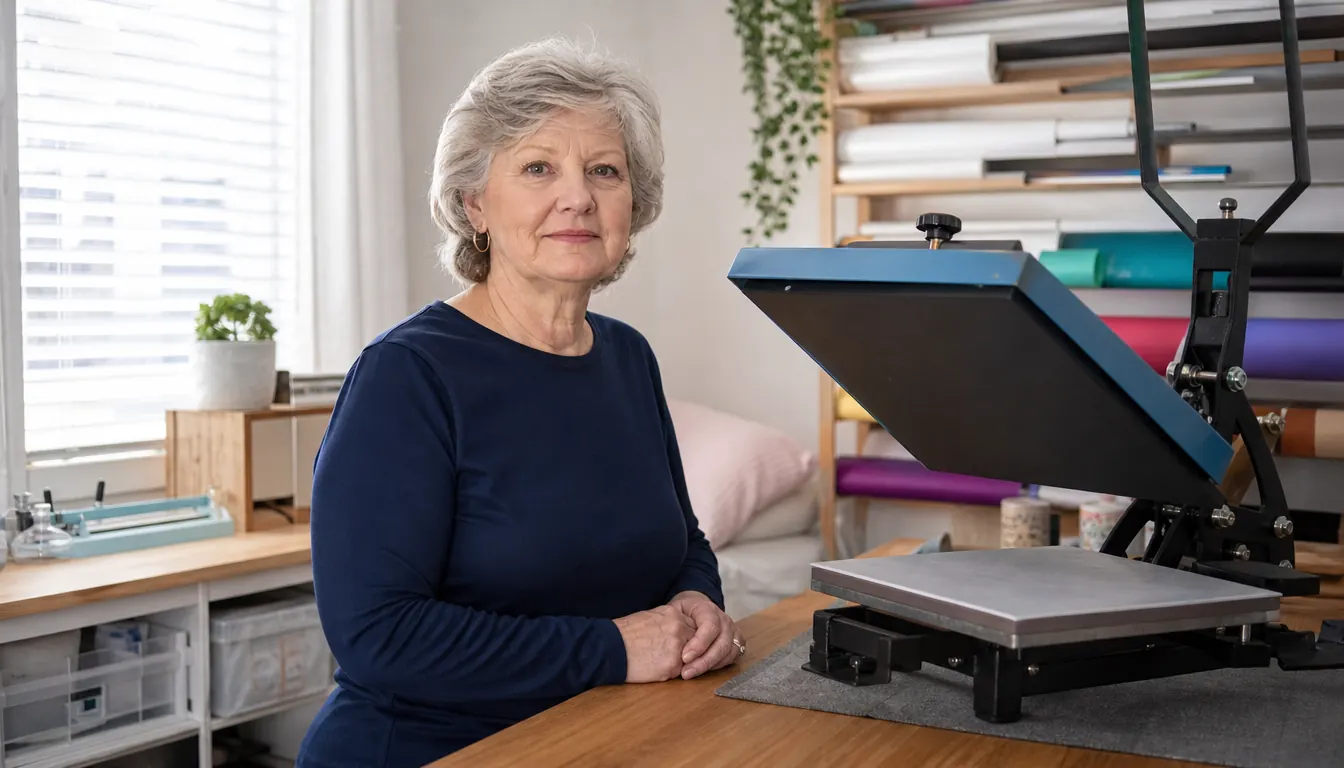
The first thing nobody tells you about a 15 by 15 clamshell heat press is that it is bigger than the photograph. Mine measures 33 inches long, 23 inches wide and 20 inches tall, and it took over one whole end of the craft table my husband Ray built me in the spare bedroom. I bought the Fancierstudio Digital Heat Press 15 x 15 in April 2025 after a long winter of pressing Mason's Little League shirts with a household iron, and I have used it most weeks since, through about 19 months of shirts, totes and pillow covers. This is the honest version of that experience, including the parts that made me say things I would not repeat in the church hall.
I am not a print shop and I never played one on television. I am 61, retired after 28 years as a school cafeteria manager here in Visalia, and I press shirts for family, friends, our church fall festival and two or three local craft fairs a year. I do this because I like it and because Lily and Mason outgrow a size faster than I can sew. So read this as one hobbyist talking to another across a craft table, not as a lab report.
The Quick Verdict
A workhorse 15 by 15 press that will outlast your beginner ambitions, as long as you accept a three month warranty and a learning curve measured in ruined blanks, not hours.
Amazon Check Today's Price →The 15 by 15 That Retired My Iron for Good
Fancierstudio's clamshell with digital time and heat control, a Teflon coated platen, 1800 watts and a 15 by 15 heat press sheet in the box. It is still the press on my table every week.
Amazon Check Today's Price on Amazon →How I've Actually Used It
Before April 2025 I had never touched a heat press. My whole method was a household iron, a cotton pillowcase as a pressing cloth, and heat transfer vinyl I cut out with scissors, which is exactly why the letters on Mason's first team shirts started lifting at the corners after a few washes. The box arrived heavy enough that Ray carried it in for me. It has sat on a heat resistant mat on that table ever since. In 19 months I have pressed cotton t-shirts, canvas tote bags, pillow covers and a stack of blanks I would rather not add up. Vinyl first, then sublimation from the fall of 2025 on.
What I did not expect is how much of the job is the press and how much is everything else. The machine does one thing: it holds a flat, hot surface against a flat, cool one for a set number of seconds. Every shirt I have ruined, I ruined somewhere else. Too little pressure. Peeling too soon. A blank with a finish that never wanted vinyl in the first place. The press did precisely what I told it. I was the variable, and I was a lousy variable for the first two months.
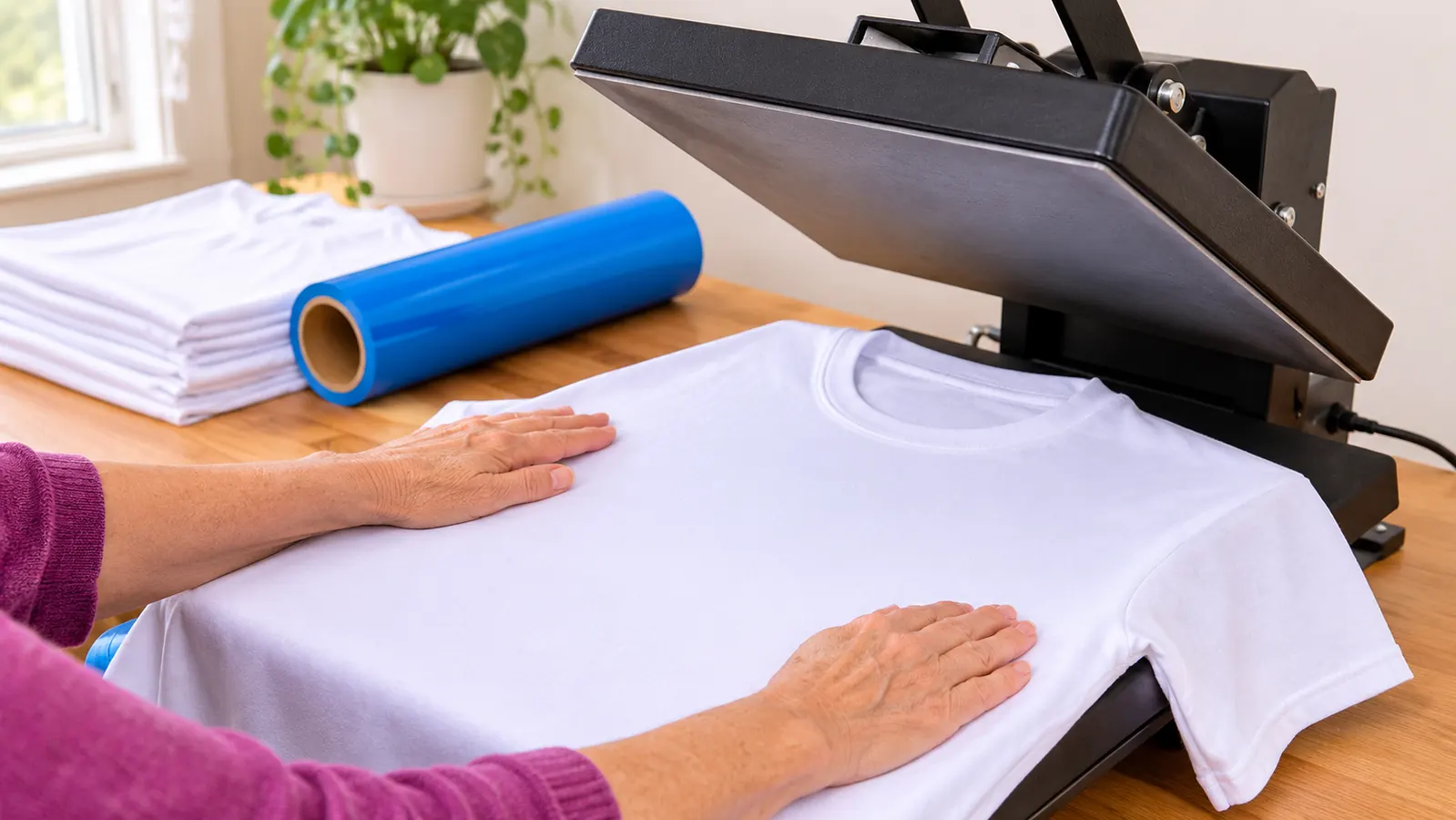
Where the Fancierstudio earns its keep is repetition. Mason's team needed 14 shirts in one weekend, and a clamshell opens and closes with one hand while the other hand holds the shirt flat. The electronic time and heat control means I set the seconds and the degrees once, and shirt fourteen is the same as shirt one. With an iron, no two shirts were ever alike and I could feel the difference in my shoulder by Sunday night. That first batch was a Saturday in April 2025 and I ran it badly. I pressed all 14 shirts at one setting without testing a single one, and by shirt six the platen had picked up enough stray lint that the back of a white tee came out with a faint gray smudge. Ray brought me a roll of paper towels and a dry cloth and did not say a word, which was kind of him. I have kept a clean cloth on the table ever since, and I wipe the platen between every batch, warm and switched off.
What Nobody Tells You Before the Box Arrives
Two things, and neither is in the product photos. First, the footprint. This is not a gadget you put away in a closet at the end of the evening. At 33 inches long and 23 inches wide it needs a dedicated surface, and it needs a sturdy one, because it has real weight and because you lean into it. Second, the circuit. It draws 1800 watts at 110 volts, which is a space heater's worth of pull from one outlet. Ray moved mine onto its own circuit after I blew the breaker with the box fan and the little cart heater running at the same time. If this is going in a bedroom, find out what else is on that line before you plug it in. Our house was built in the sixties and the spare bedroom shares a line with the hall bathroom and the outlet by the back porch. Ray found that out with a circuit tester on a Sunday afternoon, and it took him the better part of two hours to trace it through the attic. If your husband is not a retired pump mechanic with a tester and a headlamp, an electrician will charge you for the same afternoon. It is still worth knowing before the press is sitting on the table.
The third thing, and the one I wish I had read more carefully, is the warranty. It is three months. Three. On a machine you expect to keep for years. I am not calling that a dealbreaker, because mine has run 19 months without a hiccup, and the listing carries 9,550 ratings at 4.6 stars, which is a lot of people who did not push theirs to the curb. But buy it knowing that after month three, you are the warranty. Treat it like a machine, not like a toaster.
Pressure and Time Are Where the Learning Curve Lives
The controller handles time and temperature and it handles them honestly. You set a number, it holds that number, and the readout tells you where it is. What no controller can do for you is pressure, and pressure is the thing that decides whether a design stays on through 30 washes or peels on the first one. I learned that on a stack of canvas totes. Too little pressure and the vinyl sits on top of the weave without ever bonding. Too much and the platen leaves a shine on the fabric that no amount of washing takes out.
The temperatures I use are not exotic. For heat transfer vinyl I start with whatever the vinyl maker prints on the roll, then do one test on scrap fabric before I touch anything real. For sublimation I start with the blank maker's recommendation and adjust from there. The listing gives a temperature range up to 699 degrees with an upper temperature rating of 500 degrees, and a time range up to 999 seconds. You will not need the top of either range for shirts. You will use the timer constantly, which is the entire reason a digital control beats counting Mississippi in your head while you hold a handle down.
The machine was never the problem. Every shirt I ruined, I ruined with pressure, timing or plain impatience.
The Annoyances, in the Order They Bother Me
The handle takes real force to close and lock. I am 61 with a cranky right shoulder, and by the end of a 20 shirt batch I notice it. Ray does not notice it. If your hands are arthritic or your grip is not what it was, press a friend's machine before you buy one, because there is no gentle way to bring a clamshell down. This is the single most common complaint I hear from women in my church craft group, and it is not a flaw so much as a fact of the design.
Second annoyance: everything around the press wants to move. The mat creeps across the table, the shirt shifts the instant you lift the handle, and a tote bag with a long strap wants to fold itself under the platen at the worst possible moment. I fixed most of it with a couple of strips of double sided tape under the mat and a lot of practice holding seams flat with my fingertips well clear of the hot edge. None of that is the machine's fault. It is just the job.
Third: the platen is Teflon coated, which is genuinely good, and it also means you cannot tell at a glance whether it is clean. Vinyl residue and stray threads bake onto it slowly. I wipe mine with a dry cloth while it is warm but switched off, and once a month I go over it properly. A dirty platen shows up as a faint outline on the next light colored shirt, which is a sad and entirely avoidable way to learn.
What I Ruined First, So You Do Not Have To
Shirt number three was a white cotton tee for Lily with a rainbow across the chest. I scorched a pale yellow rectangle into it because I trusted the number on the display and skipped the test press. Cooked cotton does not come out. That shirt lives in a bag in the closet with its friends as a reminder: the press will do exactly what you tell it, including when you tell it something foolish. Ten minutes of scrap fabric testing would have saved it.
The other early disaster was peeling too soon. Warm peel and cold peel are different instructions and the vinyl maker tells you which one you have. I got impatient, peeled hot, and watched the outline of a letter lift away with the carrier sheet. On sublimation blanks I learned about ghosting, which is what happens when the paper shifts a quarter inch between the first press and the second. Tape the paper down. Tape it down like you mean it, on all four sides, and check it before you close the press. I also burned a corner of a canvas tote once, because I pressed it folded double, so the platen was sitting on four layers of canvas instead of two. That corner went from pale to toffee brown in about eight seconds and it smelled like a campfire in the spare bedroom. I opened the window, ran the fan, and put the tote in the bag with the scorched tee. Two ruined pieces out of my first dozen is not a terrible record for someone who had never touched a press, but I would rather have spent that money on blanks that lived.
What the 15 by 15 Platen Actually Buys You
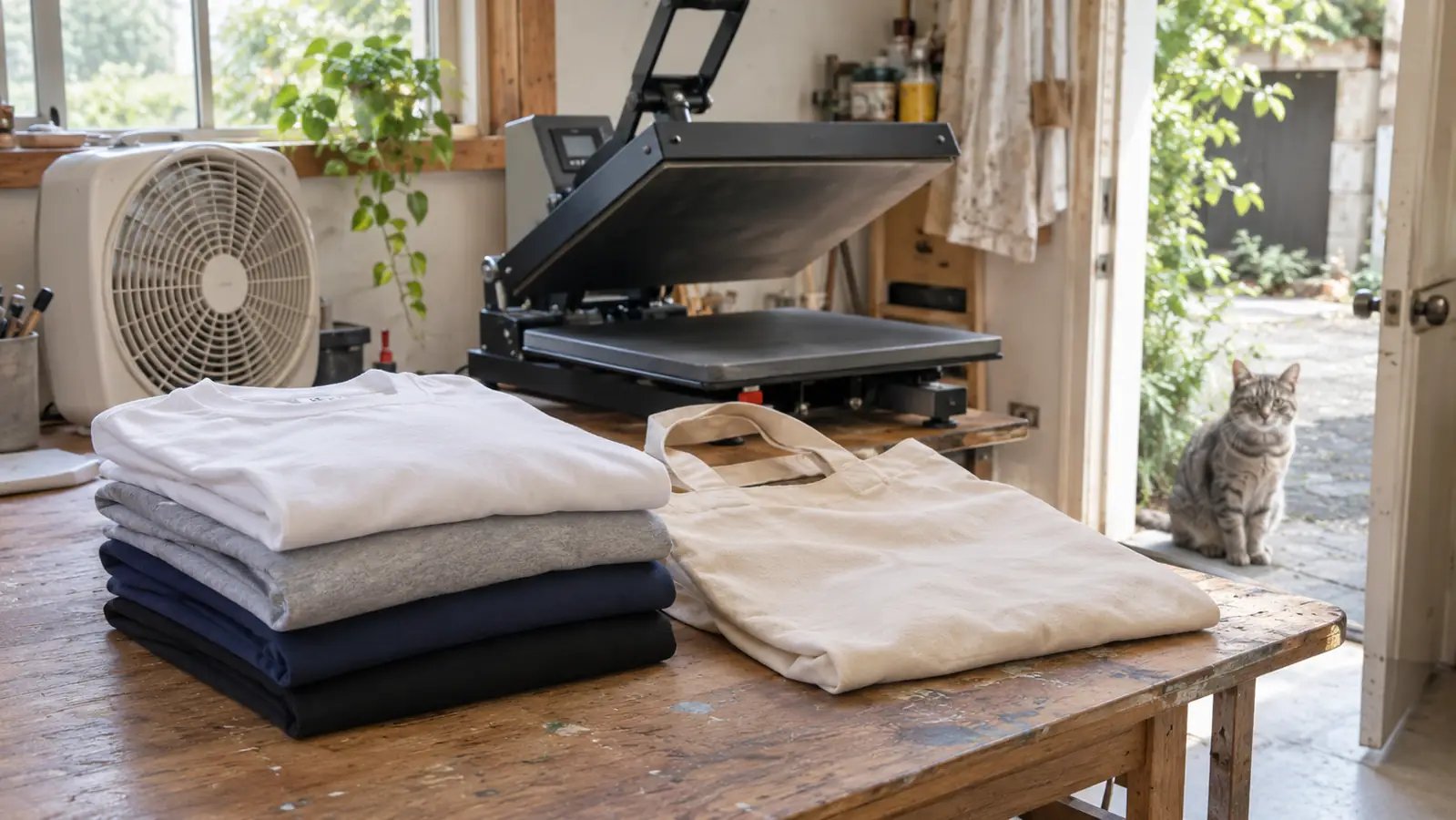
Fifteen inches square is the sweet spot for what I do. A youth large or an adult 2XL front print fits inside the platen without repositioning, which means one press instead of two and no seam line running across the middle of a design. Totes fit. Pillow covers fit if I fold them carefully and press the second half after the first has cooled. The listing names bags, mouse pads and t-shirts as the recommended uses, and after 19 months I would add pillow covers and the occasional apron to that list.
The press also came with a 15 by 15 heat press sheet in the box, which I used until it got grubby enough to replace. I liked that it was included rather than sold separately. It is a small thing, but small things add up when you are buying your first machine and have no idea what else you are supposed to own.
Heat Safety, Ventilation and the Cat
Pepper is not allowed in the craft room while the press is warm, and that is a rule, not a preference. A platen gets hot enough to burn skin in a second and there is no way to childproof a surface that has to stay open to work. I open the window, run a small box fan on the sill, and I never leave the room with the press switched on. Not for a phone call. Not to let the cat in. Sublimation in particular puts off a smell when you press paper onto polyester, and in a spare bedroom ventilation is not optional. I keep a small fire extinguisher under the craft table, the kind you can grab with one hand, and I check the date on it every January when I pull the press forward to sweep underneath. Nobody thinks she needs one until the afternoon she does. I also unplug the machine when I am done for the day instead of just switching it off, because a hot appliance on a bedroom outlet is not something I want sitting there while I sleep.
The same goes for kids. Mason is 10 and Lily is 7 and neither of them touches the handle, the cord or the table while it is on. I press when they are at school or in the yard. If you are buying this to craft with grandchildren in the room, decide now where the boundary is, because a hot press and a curious seven year old should never be in the same square of floor.
What I Liked
- Fifteen inch platen takes youth through 2XL fronts in a single press with no seam across the design
- Digital time and heat control holds a setting, so shirt fourteen matches shirt one
- Teflon coated platen releases vinyl cleanly and wipes down easily
- 1800 watts heats up and recovers quickly between presses in a batch
- 19 months of weekly hobby use with no mechanical trouble
Where It Falls Short
- Three month warranty is short for a machine you plan to keep for years
- Heavy, and it claims a permanent 33 by 23 inch footprint on your table
- The handle takes real force to lock down, hard on shoulders and hands
- Pressure is set by feel, not by a number you can read off the control
- 1800 watts will not share a circuit quietly with much else
Who This Is For
This is for the person who has outgrown an iron and wants one machine that will handle flat blanks for years without turning into a second hobby. If you are pressing team shirts, family shirts, tote bags for the church festival and a few pillow covers, this press is more machine than you need, and that is exactly the point. It has lived in my spare bedroom for 19 months and the only thing I have had to buy is more vinyl and more blanks.
Who Should Skip It
Skip it if your main interest is tumblers and mugs. Flat clamshells are not the tool for a curved surface, and you would be fighting the machine every time. I do tumblers on a separate press and I would not try it any other way. Skip it if your craft space is a dining table you clear every night, because this does not go back in a box. Skip it if you have shoulder or grip trouble and nobody around to help you close it. And skip it if you want something you can walk away from while it runs, because nobody should do that with any press.
The one thing I would tell a friend before she clicks buy is this. Budget for the press, the blanks and a stack of scrap fabric to practice on, in that order, and expect your first three projects to be learning experiences rather than gifts. Mine were. The press survived them, and so did I.
Nineteen Months In, I'd Buy It Again
Same press, same table, same routine most weeks. If you are ready to retire the iron, start with the 15 by 15 and a pile of scrap to practice your pressure on first.
Amazon Check Today's Price on Amazon →